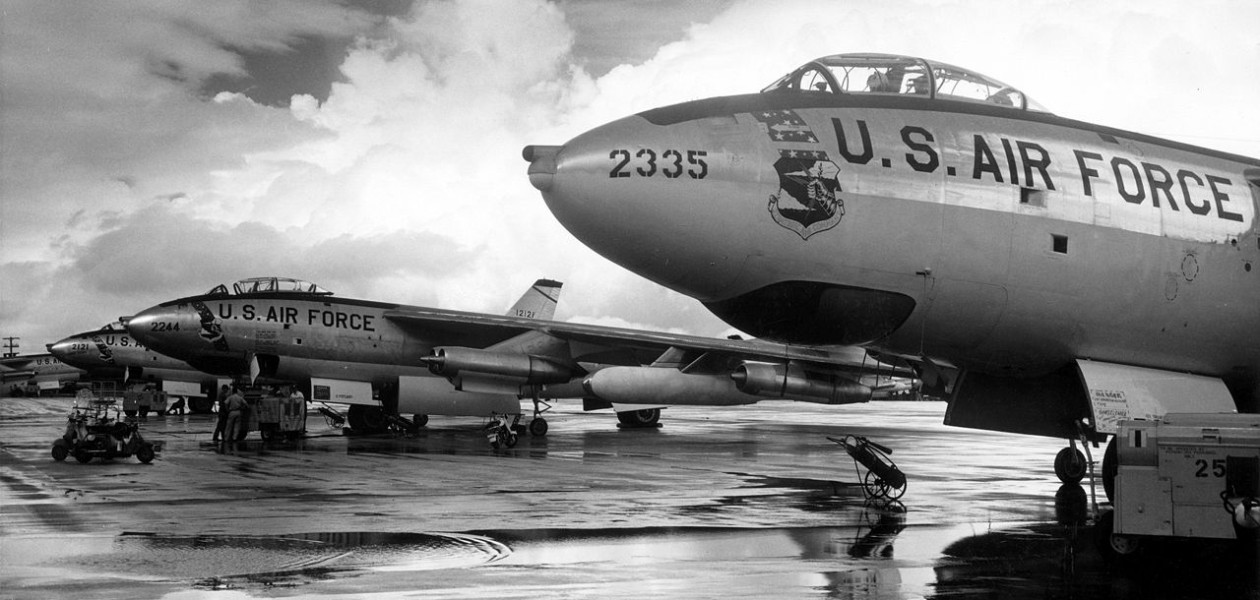
The Saga of
B-47E 53-6244
In February
1965, 307th Bomb Wing B-47 number 53-6244, the last B-47 produced,
was flown from Lincoln AFB to Wright-Patterson AFB, where it was to be entered
into the Air Force Museum.
Unfortunately, in the long run, it didn’t quite work out that way!
In 1992 and
1993, articles published in the 307th Bomb Wing newsletter described
the eventual fate of 6244. Since then,
the 307th Bomb Wing Association has gained many new members who
never got to read about 6244, and who have asked many questions concerning her
fate. Also, in the years following
these newsletter articles, we have come into additional material, some photos,
and another historical account, written by a student as a junior high school
research project.
In order to update the record, the original
1990s articles are reprinted below, along with other material including the
student’s account and photos that were not available earlier.
*****
According
to the aircraft data records from the Air Force Historical Research Agency at
Maxwell AFB, Alabama:
“The B‑47E, s/n 53‑6244, was
manufactured by Boeing Aircraft, Wichita KS and delivered to the USAF on 24 Oct
1956. Its assignments were:
Oct 1956 To 40th Bombardment (M) Wing (SAC), Smokey
Hill AFB KS.”…
Lt Col Ray J
Notley, USAF Ret, a member of the crew who picked up 6244 at the Boeing plant,
writes of the event:
B-47E SN 53-6244 Built at
the Boeing Wichita Plant, SN 53-6244:
Crew S-36 took possession in mid 1956:
Crew members were Captain David W Clark (A/C), 1/Lt Ray J Notley (CP), Captain
Rodney Collier (Nav). Interesting story
surrounds the delivery of this aircraft, since it was the last one built at
Wichita, the plant workers organized a charity drive to raise money for a good
cause somewhere, the workers taped or glued coins and paper money to every
surface of the aircraft. The crew could
not preflight or fly the bird until all the loot was cleared from the entire
aircraft. It took nearly two days to do
so… Needless to say we looked at every
nook and cranny in preflight to insure that the entire aircraft had been
cleared (literally thousands of dollars of money had to be removed before we
could fly it). The flight home to
Smokey Hill AFB was uneventful. Upon
landing the maintenance crews received the bird to do their thing. When they removed the side panel from the
C/P ejection seat, they found it was still chained and locked to the floor
boards! Oh boy, so much for meticulous
preflights!
The remainder of
the aircraft data record shows:
Jan 1957 To 307th Bombardment (M) Wing (SAC),
Lincoln AFB NE.
Jul 1958 To Oklahoma Air Materiel Center, Tinker
AFB OK.
Aug 1958 Return to Lincoln AFB
Jun 1959 To Lockheed Aircraft, Marietta GA.
Oct 1959 Return to Lincoln AFB.
Jun 1963 To Douglas Aircraft, Tulsa OK.
Jul 1963 Return to Lincoln AFB.
Jan 1965 Dropped from USAF inventory by transfer.
Although
it was “dropped” from the operational inventory, custody was transferred to the
Air Force Museum, which at the time was part of Air Force Logistics
Command.
Over
it’s time in the 307th Bomb Wing at Lincoln AFB, 6244 was tended to
by several crew chiefs, those we know of being Charlie Baker, Donn Kimmel,
Bruce Stufflebeam, and Steve Vensky.
The
transfer to the Air Force Museum at Wright-Patterson AFB was a big deal for
those remaining at Lincoln as the 307th BW prepared to deactivate in
1965. Many of the 307th
troops participated in the cleaning, waxing, shining and buffing of the bird to
prepare it for its debut at Wright-Patt.
Bill Evans, Darryl Haag, Don Kimmel, Jim Sine, Bruce Stufflebeam, and
Jim Villa, and others, all spent many hours in the big hanger making her
pretty. This was important because 6244
was one of the better flying and maintained aircraft in the wing, she was the
last B-47 made, and she was also the cover girl photo on the front page of the
B-47E Tech Order. Meanwhile, the wing
went about selecting a crew and picked Capt Gene Hickman (A/C), Capt Pete Todd
(CP), and Capt Al Ottaviano (Nav) and A1C Jim Sine, crew chief, to deliver 6244
to the Museum. This privilege was a
reward for the crew’s performance in a 2nd Air Force
competition. However, for some reason,
the crew names painted on the side of the aircraft were Mitchell, Gerber, and
Evans.

53-6244 Departing Lincoln
AFB
Upon
arrival at Wright-Patterson, 6244 was displayed in the Museum’s unpaved outdoor
exhibition area for a while. For those
unfamiliar with Wright-Patterson, the Museum then occupied a rather ramshackle
hanger just east of base ops and the outdoor exhibition area later became a
parking lot after the Museum moved to its present site in 1971. At this time in the 1960s, there was an
operational SAC B-52 wing at Wright-Patterson, the 17th Bomb Wing,
located on the opposite side of the runway from base ops. The powers that be in the 17th decided to
have a display of SAC aircraft in front of their wing headquarters, and among
others, 6244 was appropriated to stand vigil there. The 307th Bomb Wing insignia on 6244’s nose was
removed and replaced with that of the 17th BW.
Then
in 1971, it became time for the Air Force Museum to move to their new facility,
located several miles distant. The challenge was the movement of the larger
aircraft located in the outdoor “parking lot”.
The only accessible route between the old and new facility was along a
busy four land divided highway. The
highway was shut down for a weekend, traffic lights, signs and other
obstructions were removed, and the larger birds were then convoyed nose-to-tail
to the new facility. The highway shut
down and preparation was a one time occurrence, not to be repeated. For some reason, not adequately explained to
this day, 6244 and the other birds in front of 17th BW headquarters
did not make it into the convoy (three or four conflicting stories or
hypotheses abound in explanation of this failure).
Apparently
folks at the AF Museum at that time were not overly concerned because they had
another B-47 in their possession. Their
B-47 had started life as an early B-47 in possession of Air Force Systems
Command, and in fact had done yeoman work as a test bed for the first
fly-by-wire electronic control system, such as now found on all modern
aircraft.
Then,
in 1976, the 17th Bomb wing was deactivated, and the aircraft lawn ornaments in
front of their headquarters were cast adrift and turned over to salvage. 6244 was towed to an isolated spot along a
back road next to the Mad River where she deteriorated, occasionally donating a
part for other B-47s in need at other museums.
She then was turned over to the Wright-Patt fire department where she was
set afire numerous times for fire crew training. What happened to her residual carcass is not exactly known.
What
follows below are personal observations, memories, and research of 6244 by Mike
Gingrich, Jim Villa and Christopher Bright.
Last of the
Line
November 1992
It was a beautiful autumn morning in October 1975;
my six year old son's first soccer game had just begun on the field adjacent to
the SAC Bomb Wing Headquarters at Wright-Patterson AFB. Because the action on the field lacked World
Cup intensity, my gaze soon wandered to the aircraft parked a hundred feet
away, where the SAC wing had a mini-museum.
I could see a KC-97, KC-135, B-52, and a B-29, but it was the B-47 that
drew my attention.
On the tail I saw the familiar green stripe of the
307th Bomb Wing, and below the stripe were the numbers 6244. Closer inspection revealed the names of the
crew painted on the side near the nose.
I knew all the names, and memories took over my thoughts. I recalled that 53-6244 was one of the
aircraft that crews liked to fly, and that I had flown it several times. A later check of my log book showed that on
9 April 59, Solomon and I returned it to the crew chief slightly bent, as we
had shut down number six following its flame out on final approach. But that did not diminish our esteem for the
bird. A nearby plaque noted that
53-6244 was the last B-47 produced, and that she had been brought to
Wright-Patterson in 1965 from Lincoln.
My intention was to return with my camera to take
pictures; however, procrastination and events displaced my intentions. Shortly thereafter, the SAC Wing was
deactivated, and when I returned with the camera, all the aircraft were
gone. No pictures! Sometime later, while visiting the Air Force
Museum, I engaged the Curator, Royal D. Frey, in a conversation about the
aircraft. Mr. Frey told me that the
Museum had hoped to put 6244 on display at the Museum, but that there had been
no way to move her from the location on the Patterson Field side of Wright-Patt,
down the highway to the Museum located on the Wright Field side. Frey explained that when the new Museum site
opened in the early 1970s, special provisions were made to move the large
aircraft from Patterson to Wright Field.
Utility poles and other obstructions along the highway were removed, and
the highway was entirely closed for one weekend while the aircraft were moved
in convoy fashion. It was, however, a
one-time deal. He regarded 6244's
situation as a loss to Air Force history, as the B-47 wearing SAC colors at the
Museum was not a SAC airplane, but an Air Force Systems Command research
configured bird, now painted in the SAC scheme (referred to by some as an “Imposter”). The actual SAC aircraft, 6244, had been consigned to the base
fire department for drills.
(Ed
note: In more modern times, the Air Force Museum has removed the wings of
larger airplanes, in order to get them to museum premises for restoration. A RB-47 was recently acquired thusly).
Shortly after my conversation with Frey, an article
in The Skywriter (Wright Patt's
newspaper), entitled "Stratojet Silently Serving," confirmed Mr.
Frey's information. According to The SkyWriter, 6244 had been used for
battle damage training before being assigned to the fire department. Described as a nesting place for wasps and
birds, she had also donated an engine and a strut to repair a tornado damaged
Stratojet at the Bradley Museum in Windsor Locks, Connecticut.
In June 1979, the Property Disposal Office evaluated
her value at one million dollars.
Considering her flyaway cost when new of about 2.5 million, she held up
pretty well for twenty-five years.
Let's see ... that's only $60,000 depreciation per year.
It seems fitting that as the last of her line, she
managed to avoid the metal slashing guillotine at the boneyard, and continued
to serve the Air Force for so long before fading away.
*****
Last of the Line, Part II
The November 1992 article, The Last of the Line, about B-47E number 53-6244, the last B-47
produced, evoked a great deal of interest and response from readers. Numerous letters and phone calls were
received from people offering additional information. Also, I did a little more digging at the Air Force Museum and the
Air Force Historical Research Agency, so it's time to let everyone know what
was found out about the bird.
We heard from or talked with Darryl Haag, Bill
Evans, Donn Kimmell, Sandor Babos, Mary K (Mrs Robert Collins), Pete Todd,
Glenn Lally, Dave Roebuck, and Dave Menard of the AF Museum's Research Division. To all these folks, thanks for your interest
and help.
Here's what was learned:
The crew that flew the plane to Wright Patterson on
22 January 1965 was Capt Eugene T Hickman -- Aircraft Commander, Capt Harold W
"Pete" Todd -- Copilot, Capt Alfred F Ottaviano - Navigator, and A1C
James R Sine -- Crew Chief. This was
determined from Jet Scoop photos
furnished by Darryl Haag, which show 6244 on the ground at WPAFB, with the crew
and the Director of the AF Museum, Col William F Curry. The photos also clearly show the 307th Wing
Crest to be on the right side of the plane at that time. In an AF Museum press release that day, Gene
Hickman states that the plane was "polished so slick, it flew 15 knots
faster than it normally does."
Gene is also on record as saying his crew was selected for the mission
as reward for being the top crew in 2nd Air Force.
According to Glenn Lally, of Enon Ohio, who was
director of the SAC Liaison Office at WPAFB at the time, the crew names painted
on the side of the plane were Mitchell, Gerber and Evans.
For display at the Bomb Wing at WPAFB, the 307th
crest was removed, and replaced with the crest of the 17th Bomb
Wing. After all, no self respecting SAC
Wing could have another wing's crest on a bird parked next to their headquarters. (Perhaps
one of our former crewmembers turned lawyer, could sue for defacement of 307th
property?).
According to the Air Force Historical Agency's
aircraft data records, 53-6244 was manufactured by Boeing in Wichita, and was
delivered to the AF on 24 October 1956, at which time it was assigned to the
40th BW at Smoky Hill AFB, Kansas. Capt. Dave Clark, A/C, Roy
Notley, C/P, Capt. Rodney Collier NAV flew the last B-47E bomber built at
Boeing Wichita, Kansas and it was assigned to the 44th BS for a short time
until transferred to Lincoln AFB NE In January 57. It was assigned to the 307th
BW until it went to the depot at Tinker for Milk Bottle mod in July 58. It returned to Lincoln in August 58, but
went to the Lockheed plant in Marietta GA in June 59, returning to Lincoln in
October. To balance things among the
various companies that produced B-47s, it went to the Douglas plant at Tulsa in
June 63, and returned in July to the 307th, where it served the remainder of
its active life.
Donn Kimmell of La Vista NE, 6244's last Crew Chief,
says that a picture of 6244 was used on the title page of all the later tech
orders. Donn also described the intense
preparation and polishing of the plane prior to the trip to the Museum. He sent a copy of a letter of appreciation
he received from the Wing Commander for his part in the effort. Donn had also heard from an acquaintance
that 6244 had been seen in Hawaii in the late 1960s as a WB-47. The AF aircraft data records seem to
contradict that rumor.
Others working and crewing 6244 were Bill Evans of
Mankato MN, and Darryl Haag, of Norwood MN.
Bill says he made a trip to WPAFB in 1972 specifically to see the bird,
but was disappointed to find he could not see it up close -- only from across
the field. SAC security you know. Darryl also remarked about the month he
spent polishing on the bird...the polish was driven out of the rivet holes by
moisture encountered during the flight, and turned into black tarnish.
Finally, just what was the final demise of good old
6244? I called the WPAFB Fire
Department and spoke with Chief Jackson.
According to the Chief, 6244 was set afire repeatedly to provide fire
suppression and rescue training; after six or seven burns there was not enough
remaining to provide further training.
So, sometime in the 1979 time frame, her remains were gathered up and
sent to the scrap yard. Her demise and
failure to get into the Air Force Museum is regarded as a historical tragedy by
the Museum staff. The Museum's AFSC
impersonator (as Pete Todd describes the B-47 on display) doesn't even have
wing tanks, so it will never qualify to become "combat ready". Still, 6244 served her nation well.
It would appear that what began as a trip to a
six-year old's soccer game in 1975, has become not only a research project, but
a significant generator of nostalgia as well.
Many of the letters and phone calls remembered not only 6244, but other
vivid recollections of the 307th Bomb Wing, B-47s and Lincoln Air Patch, as
well. In short, it has been educational
and fun!
*****
The author of the following account is Christopher J Bright,
who at the time in 1978 was twelve years old, and whose father was assigned to
Wright-Patt. Chris is now, in 2003, a
PhD candidate in American Diplomatic History at George Washington University,
where his dissertation topic is nuclear strategy in the Eisenhower era. He
writes here for a school research project.
B‑47E,
tail number 53‑6244 sits
quietly amongst sister aircraft of her era.
The other aircraft surrounding her are‑charred, twisted and
mangled, some even beyond recognition.
But amazingly, 6244 has not yet met such a terrible, fiery fate. There she sits, at the Aircraft Fire
Training Center, her dulled fuselage and
wings far from the way they gleamed that day in January of 1965.
I
first saw 6244 when driving with my family along a back road on Wright-Patterson
Air Force Base. We came upon a clearing, we saw, as described above, the
remains of many different aircraft.
Ahead loomed this magnificent aircraft.
Curiosity was aroused. I knew
this aircraft was at least fourteen years old.
I wondered where did she serve?
What missions did she fly? Why
is she now resting here? What about her
crewmembers? What is their fate
fourteen years later?
I
quickly jotted down the aircraft number from the tail section of the
aircraft. I thought that I would be
able to send this information to the headquarters of the Strategic Air Command
for the answers to these questions.
The
return letter from SAC was quite disappointing. The letter said that they were unable to answer my questions
because they do not keep the records of out of service aircraft. However, they went on to say that they had
forwarded my letter to the office of information at Wright‑Patterson.
A few weeks later I received a form letter from Sgt.
Oscar Seara from this office. Sgt.
Seara said, that again my letter had been forwarded, this time to the Albert H.
Simpson Historical Center, at Maxwell Air Force Base, Montgomery Alabama. My morale hit an all time low, I thought I
would have gotten some sort of information.
However, I held out that maybe the historical center could help me.
The response from the historical center came two
weeks later. The letter read in part, "We believe the aircraft in your letter,
partial serial number 6244 to be the B‑47E 53‑6244. Manufactured by the Boeing Aircraft
Corporation, Wichita, Kansas, it was delivered to the USAF October 24,
1956. For a short time (Oct. 1956‑Jan.
1957) it was assigned to the 40th Bombardment Wing (SAC), Smoky Hill AFB
Kansas. It was assigned to the 307th
Bombardment Wing (SAC), Lincoln AFB
Nebraska from January 1957 to January 1965, when it was dropped from the USAF
inventory." This letter raised my morale greatly. However, this wasn't
enough information to satisfy me, because the historical center had not
answered all my questions.
I
then decided to send two duplicate letters, one to the Air Force Times, the
other to the Air Force Magazine, asking to hear from any former crew members or
other people associated with this aircraft while it was stationed at either Air
Force Base.
The
response was terrific. Within two days after my letter was published in the Air
Force Times, I had calls pouring
in. The first call that I received was
from Dan Friedlander, who lives in Columbus. He used to be a mechanic stationed
at Moron, Spain. He said 6244 used to,
along with the other planes, of the 307th Bombardment Wing, fly Reflex missions
to Moron from Lincoln. This meant the
planes stayed at Moron for a few weeks on a "special alert”. Then they would fly back to Lincoln.
Mr.
Friedlander said the reason he remembers 6244 so well is because it rarely
needed repair and all the other mechanics looked upon 6244 with great
admiration.
Mr.
Friedlander recalled one time, after he "launched" the aircraft the
landing gear would not retract. Steve
Vensky, a crewmember at that time, had to crawl down a special passage way
running through the center of the fuselage to check the landing gear
system. All this while flying! Mr. Friedlander assured me this was not an
easy task. The bomber could not land
because of the amount of fuel at this time.
The problem was finally corrected, and after a short period of time, the
bomber landed.
The
second telephone call I received was from Lt. Col. Mike Gingrich, who at
the time was a 1st Lt. Although Lt. Col. Gingrich never flew the plane on
Reflex missions to Spain, he flew the plane a total of twenty‑two hours
on simulated bomb runs over the northeast of the United states. He recalls one such flight, April 9, 1959,
the day Queen Elizabeth was visiting Chicago they had a ''flameout" on
number 6 engine over Chicago, ‑ In other words, the engine became
inoperative. Lt. Col. Gingrich also
told me that he believed the names stenciled on the aircraft under the cockpit
are the names of those that won the wing bomb championship. One thing Mr. Friedlander told me in his
previous telephone call is the fact that the bomber used to be at the Air Force
Museum at Wright‑Patterson. Mr.
Gingrich confirmed this and said that the names on the airplane are those that
were on it when it was at the museum.
Mr. Gingrich gave me additional names of crewmembers (I was compiling
quite a list).
Things then lulled, just as I was completing my
research, I received a very interesting letter from, a Col.Harold W. Todd, who
at the time he flew 6244 was also a 1st Lt. who was fresh from B‑47
combat crew training. Col. Todd said that the last B‑47 built was
"none other than 6244", which was why it was at the museum. Col. Todd and his co‑crew members had
won a Second Air Force wide "crew knowledge" championship. Because of this, they were chosen to fly the
aircraft to Wright Patterson. The
weekend before 6244 was to be flown to Wright‑Patterson "dozens of
young airman, using 500 lbs. of polishing compound" shined 6244 until it
looked new. Col. Todd swears that
because of the polishing, the aircraft got ten knots more per hour on its
flight to Wright ‑Patterson. Col.
Todd said that this day in January of 1965 (ironically the day that Winston
Churchill died) was slated to be the "media event of the season at
Lincoln, cameramen, local TV folks, and the whole wing staff was present. However, Col. Todd reports, "Only one
Problem. Ever been in Nebraska in January? Well, on this particular day, the
fog would have made Londoners green with envy.
The bright, sleek machine was dulled by the weather into a barely
discernible hulk looming in the murk. The media people were disappointed; the
wing commander was apoplectic; the flight crew was just happy the weather
lifted enough to let us get off the ground with our treasure”.
Col.
Todd continues: "Arrival at Wright‑Pat was considerably more
festive. The airplane was met with all
appropriate pomp. We were told very solemnly that our names would be stenciled
on the aircraft". (the names on the aircraft are those that won the wing
bomb championship, unfortunately, Col. Todd and his other crew members' names
are not on the aircraft as Col. Todd believes)
"so all the many thousands of visitors to the museum could marvel
at the legendary, intrepid airmen who had harnessed and delivered such a noble
steed! We emptied her of checklists and parachutes for the last time and were
driven away to town secure in our knowledge that "our" airplane would
always stand proudly among the other mint condition examples of American
aviation prowess."
If
Col. Todd had only known this not to be true; however, rusting at Wright-Patterson
she still serves a valuable purpose ‑ to teach some young firemen how to
put out an aircraft fire in this era of aircraft. Possibly she will still save
some lives in this duty of hers.
Ed:
In addition to those mentioned above, Chris Bright also heard from Al
Kulikowski and Cornelius Cosentino during the course of his research.
****
MY JOURNEY TO
THE LAST B-47E, 6244
By James Villa
When did I get interested in
airplanes? I don’t remember but I do
remember my first toy airplane. It was
a small red plastic P-40 War Hawk that my grandmother bought for me while in a
department store in Houston. Over my grade school years I would see airplanes
in movies and build model airplanes. I
would read anything about airplanes and I spent a lot on comic books with
airplanes. Whenever we were traveling
at night, I would look at airport beacon lights and imagine what was there at
the airports. I would watch as distance
came between us and their locations.
As I got older, there came several
opportunities to go for rides in small civilian airplanes. I couldn’t ever get to go to an airshow; the
only airshows that I knew of were held at Ellington Field between Houston and
Galveston. In those days (early l950s), that would be an all day trip. During my high school years, I would do
reports or essays whenever the reports would be acceptable for the subject
requirements. The Wright brothers were
my idols then, but now I know that they were not the first to do powered
flight. What I do know to be true, is
they were the first to photograph powered flight.
In the early 50s, the B-36s would be
flying a lot over where I lived. The heavy drone of their engines could be
heard almost before a person would see the monsters. When the airplanes would
pass over our old house, the windows would vibrate. When I would be working in the fields, I would watch the big
airplanes until I could not see them anymore.
Along about l955 or l956, the movie “Strategic Air Command” with Jimmy
Stewart and June Allyson came out. It
was a must see film. I soaked up every second of the B-36 scenes. I didn’t pay
a lot of attention to the B-47 part. I
never would have dreamed that one day I would serve in the Strategic Air
Command and be a B-47 crew chief.
When I graduated from Bellville High
School in l957, I really didn’t know what I wanted to do. I worked construction during the summer
months. That fall I fell in with some of my friends and we went to college. I
graduated from Blinn and transferred to Texas A&M as a junior. Airplanes had drifted far from my mind.
It didn’t work out at A&M. I realized
the playing field was more complex. I
didn’t have it – I failed chemistry (a C- was rated as a 76). What was worse, I was paying my own way and
I was out of money. I was in debt.
I decided to drop out and go back the
next fall. I got a job and was doing fairly well. Then I did what many had
done. I bought another car and a large
amount of what I was making went into it.
Time passed. Before I knew it, the fall semester was there. I decided to
further delay going back to college until the spring semester.
Lo, and behold, I lost my college
deferment. In those days, all young men
were required to register for the draft.
There wasn’t any lottery system.
When a person’s number came up, he was inducted unless he was declared
unfit. The draft board had reclassified me lA and sure was interested in me.
I had no desire to go to the Army. I
never considered myself a very strong person.
The Navy was out. I don’t like water deeper than what is in a bath
tub. The Marines was not a good choice.
It was then I decided to volunteer for a four year enlistment in the Air Force.
I was back on track thinking about airplanes.
I wanted to be a turret gunner, mainly
because of an old war movie. One of the
turret gunners always carried a camera, taking photos. Without a college
degree, I didn’t think I could be a pilot.
When I reported for enlistment, I was
told that there wasn’t any need for gunners anymore. So I chose aircraft or
missile maintenance. Later, at
Lackland, I narrowed my choice to aircraft maintenance. If I couldn’t fly on them – I could work on
them.
I sweated passing the physical
examination. I had injured both knees
during my teens and thought they would not pass. I wanted desperately to go
into the service since my Uncle Joe Villa and Uncle Jessie Villa had served in
WWII in extreme combat conditions. It
was my time to serve.
I passed all the induction requirements
and away to basic at Lackland. I’m sure
anyone who has been in the military will agree with me that basic training is a
rude awakening. I would do only five
weeks of basic at Lackland and finish the other three weeks at Amarillo AFB,
Texas.
At the aircraft mechanic school at
Amarillo, we were given a choice – fighters or bombers. I thought – bigger the better –and went into
bomber mechanic school. I was right
where I wanted to be! The school had
two B-47s. Before the thirteen weeks were over, we had thoroughly gone over the
airplanes. We learned all of the
systems. Some of us were trained as system’s specialists. I was rated for general aircraft
maintenance. At the time I had no idea
what I would be doing.
When I thought about joining, I wanted to
be stationed overseas. I wanted to be stationed on some Pacific island. You know; sandy beaches and blue water
lagoons. When I got my orders (after
graduating from bomber school) assigning me to Lincoln AFB, Nebraska, I had to
get a map to see where in the heck the place was. Right in the center of the United States!
I arrived at Lincoln AFB, I was assigned
to the 307th Maintenance Squadron.
While processing in, I was selected to stay in the orderly room and work
under T/Sgt Maynard Reece. I was only
supposed to work in the records section for two weeks and then go out onto the
flight line. Another man had been
selected (he volunteered) to stay in the orderly room for six weeks but he had
a medical problem and was discharged. I
would assume his position and still be under Sergeant Reese’s supervision.
I continued duty in the orderly room
after the six weeks passed. The work
wasn’t that difficult, and I could always stay neat. I revised all of the technical orders we operated by. Plus I
handled the aircraft forms that had to be processed. But finally I asked Sgt. Reece when I would be going to the
flight line. He said if I wanted to
stay in the orderly room, he would see to it.
I told him no. I trained as an aircraft mechanic and I wanted to be with
the airplane.
Sergeant Reece was a fine person and
sometimes I regretted asking to leave.
Worse yet, some forty one years later I learned that Sgt. Reece had been
murdered by an estranged son-in-law.
I was assigned to “A” section, C flight
when I arrived on the flight line.
Since I was semi-skilled with a three level rating, I worked with
assigned crew chiefs. Here I found that
a person better learn real fast. We were in real business where people’s lives
depended upon our work. SAC demanded
rigid scheduling. The mission was to always be ready to launch the nuclear
uploaded aircraft to retaliate against any aggressor. The crew chiefs were responsible for training the new men and at
the same time responsible for 2.5 million dollar airplanes.
Everyone, Airman First Class, on down
had to do a tour of three months in the servicing section. I worked the midnight to eight shift
refueling, defueling, towing and positioning B-47s. We were a crew of five men.
During these three months, November, December and January; I would
experience my first winter in Nebraska. (I had always wanted to see snow and I
sure did!)
When I returned from the servicing
branch, I worked with different crew chiefs.
It wasn’t long before the “A” section NCOIC, CMSgt. Matthew Pelikan
decided to pull me in to take care of the “A” section records. I had choice
duty again. But now I could see our B-47s sitting right out there in front of
our section trailer. I had to ask again
to go out on the flight line. This time
it wasn’t hard to get a replacement for me (another man was eager to have my
job).
I was assigned to S/Sgt. Steven Vensky to
continue training for the five level upgrade.
Steve was the assigned crew chief on 6244, which is where I first
crossed paths with the airplane. Steve
would be promoted to T/Sgt, and moved out of “A” section. S/Sgt. Pressley (we called him Elvis, of
course) became the assigned crew chief.
I helped him on 6244. Before long the AlCs were doing a lot of the
launches. A staff sergeant could have
two or more airplanes assigned to his name even if someone else would maintain
and launch the airplanes.
6244 was the newest B-47E at Lincoln
AFB. The airplane went first to the 40th
Bomb Wing at Smoky Hill AFB (later named Schilling AFB), Salina, Kansas. Why the B-47 was transferred to the 307th,
we never knew.. I would meet a crew chief many years after I was out of the Air
Force who knew why she was transferred to Lincoln AFB. He said that the Air Division Commander
stationed at Lincoln AFB requested 6244 for his personal airplane for when he
would fly. “She” (many crew chiefs
referred to the airplanes as “shes”; we assumed that we just fell in love with
them) was a fully equipped B-47 with the latest ECM (electronic counter
measures) units.
After gaining my five level and promoted
to A2C, off to alert I went. I worked
on 6244 every once in a while (maybe a regular launch or a tour on alert with
the airplane). I don’t recall ever
doing Reflex TDY with 6244 in England or Spain. When I was required to get my flying time in, I flew as the
“fourth man” on any of the bomb wing’s assigned aircraft.
I was on alert duty (December 64) when I
heard 6244 was being sent to the USAF museum in Dayton Ohio. I went down to the regular flight line in an
alert vehicle by myself. It was early
on a Sunday morning just as the sun was coming up when I took the photos of
6244 that I have in my web site.
The following January, we cleaned and
polished 6244 into immaculate condition.
All the squadrons were involved in preparing the “bird”. New paint and stenciling were applied
6244 was kept in the southeast quarter
of the giant hanger. The airplane was
taken out only to be refueled and for running the engines. A2C Bruce Stufflebeam and I did some of the
maintenance ground preflight in the hanger on the morning of museum flight
launch. Before daylight, the airplane
was towed and parked in front of Base Operations. Once there, Bruce and I continued the ground preflight with
external power connected.
When the flight crew arrived there were
a few photos taken with the Wing Commander, Colonel A.W. Holderness. The weather wasn’t very cooperative that
morning. It was overcast and a light
drizzle falling. I heard there were
supposed to be some people out from the city of Lincoln, but they didn’t show,
for some reason.
The aircrew climbed aboard and commenced
engine start. When Captain Hickman was
ready to taxi, he told me to disconnect and I wished the crew a good
flight. That was the last time I said
anything over ground headsets. Bruce
and I closed 6244 up for the last time. Bruce and I rode with the maintenance
officer, Lt. Colonel John Crook, out to the edge of the main runway and watched
6244 takeoff and disappear in the low overcast.
This was my last launch of a B-47; also
my last work day on the flight line. I
was getting out of the Air Force and would start clearing base. It still is amazing to me that I would be
involved in sending the last tail numbered B-47 on its last flight and to a
museum. Base politics at the USAF museum would change this historical event.
Almost six years passed before I had
the opportunity to travel to the USAF museum in Dayton, Oh. I can’t explain the excitement. I walked out
to the open display area where 6244 sat.
At first glance, I saw the airplane wasn’t being cared for. I noticed the rudder was unlocked and the
right outrigger tire was flat. What
really set me back; our crew member’s names had been replaced. I walked around
6244 the same way we did the ground preflight inspections. I saw the 307th
crest had been replaced with another (l7th Bomb Wing). I couldn’t help wondering what had taken
place. But it was great to see 6244. I
walked around with a young couple showing them a lot about the airplane. Then I sat on a bench under the B-36’s right
wing for a long time remembering. I had
no thought that this was the last time that I would set eyes on 6244.
In
l997, I had planned a stop in Dayton to see 6244. The airplane was not on display.
Instead, Wright-Patterson’s test bed B-47 was sitting in the
museum. I asked a few of the museum
people what had happened to 6244, but I could have asked the museum walls and
gotten the same answer.
We came away from the museum theorizing
that the airplane had been moved to another museum. I had heard a SAC museum was being built in Nebraska. Maybe 6244
had been moved there. Or maybe
the airplane had been taken back into service and ended up being stored
somewhere. I hadn’t heard at the time,
all but two of the l400 plus B-47s sent to Davis Monthan AFB at Tucson had been
scrapped. It had been stated that the
airplanes would be useful if needed until year 2000,
In 2002, I found the B-47
Association. Immediately I sent an
application for membership. The
president of the association sent me the latest newsletter. I opened the
newsletter, The photos of 6244, taken on January 22, l965, caught my eye. I was thrilled! There were the three photos taken that morning; but there was a
fourth photo. The fire training school
at Wright-Patterson had used 6244 for training. The airplane was eventually destroyed. I must admit I uttered some very choice, unprintable words.
Over the past years, I have been
searching out details about 6244’s removal from the museum. There have been several different reasons
for replacing 6244. None of them hold
much water. The most recent version is
that 6244’s wings drooped too low and would not clear sign posts and fences
when all of the museum’s aircraft were moved to a new museum site. What is most apparent, Wright-Patterson AFB
wanted their B-47 in the museum and coveted 6244’s display slot.
The removal of 6244 from the museum was
quite a blow to me. Many of the other 307th Bomb Wing people have
indicated their feelings of resentment toward the USAF Museum. One ex-307th person, instrumental
in placing the B-47 Association’s B-47 Memorial in the museum’s memorial park,
made sure 6244’s tail number is on the B-47 image displayed on the monument.
So, in a sense, 6244 is finally in the AF Museum.
I think how blessed and privileged I am
to have experienced this story. I remember the mission of the Strategic Air
Command down to the smallest detail. I
can still smell the exhaust of the engines. I remember the weather conditions
under which we maintained the airplanes. I remember how all of us (aircrews and
maintenance people) worked together to operate one of the most powerful
deterrence force that ever existed. I
could go on and on. If I could do it
over again, I would do it in a heartbeat.
But what I remember with a sad heart
is, we lost some of our people in crashes and accidents. During the ten plus years, while the B-47s
were operating out of Lincoln AFB, Nebraska; more than 35 crew members were
killed in B-47 crashes. Lincoln AFB
would experience a loss of 50 officers and enlisted, returning from England by
the way of the Azores, fifty one years ago this past October (2007). They went down in the Atlantic and no trace
of them was ever found. They were on
the first airplane returning to Lincoln AFB after a 90 day TDY in England. They were all married and some had families.
FREEDOM IS NOT
FREE!