|
|
|
|
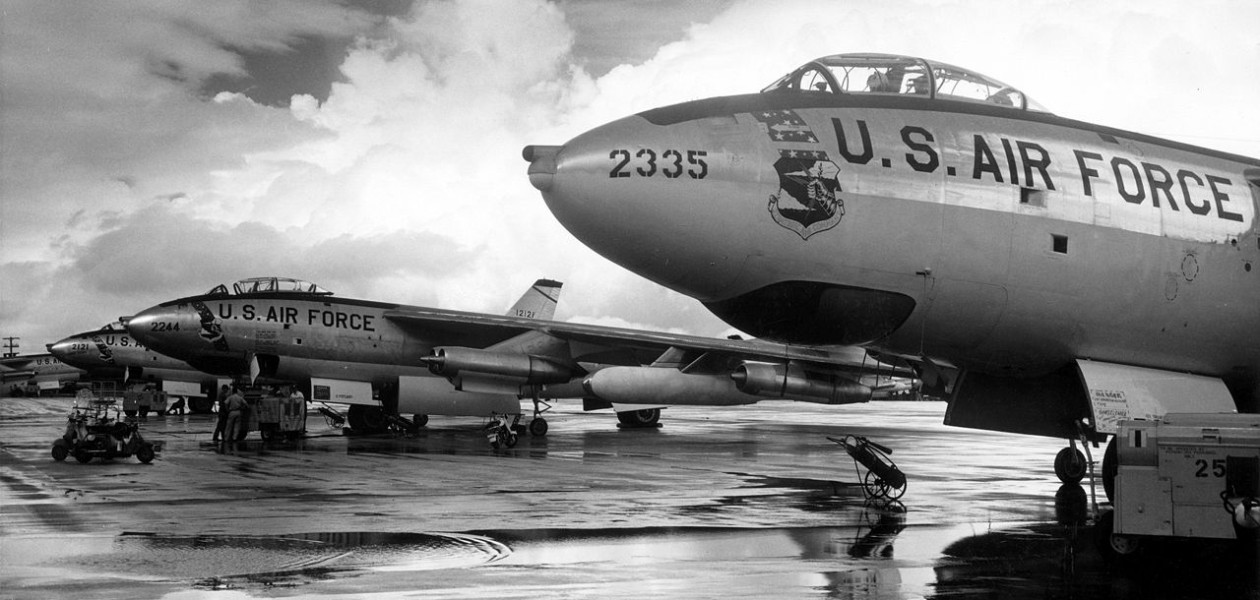
The First B-47 Pilot Bob Robbins May 15, 1916 - May 18, 2005
Bob Robbins was a lifetime member of the B-47 Stratojet Association. He had attended all the reunions except the last one held at Dayton, OH last year, being unable to attend due to health problems. Bob
Robbins will be remembered as being the Test Pilot of the XB-47 prototype that
first flew on 17 December 1947, with fellow test pilot Scott Osler. The aircraft
flew from Boeing Field in Seattle to the Moses Lake Airfield in central
Washington State, in a flight that lasted 52 minutes. There were no major
problems, except the newer radical design and shape made the plane hard to stop
on the shorter runways back then until the drag chute concept was utilized.
Bob
had originally been skeptical about the XB-47, saying that before the initial
flight he had "prayed to God to please help me" through the flight.
The aircraft was so unusual that he simply didn't know if it would fly. Robbins
presently realized that he had an extraordinary aircraft. A
story relating to the ability of the new B-47 Bob enjoyed telling over and over
was about Chuck Yeager, the first man to fly faster than the speed of sound:
Chuck
Yeager & Bob Robbins A P-80 Lockheed Shooting Star being
used as a chase plane for some tests had Chuck Yeager flying it. Bob related
“Chuck's a hell of a good pilot, but he had a little bit of contempt for
bombers and a little disdain for civilian test pilots.” Well, we took off,
climbed out, and got up somewhere within four or five points of full throttle
speed. At
that point he relates, Chuck called me on the radio and said: "Bob, would
you do a 180?" I thought: Hey, Chuck's smart, he just wants to stay
reasonably close to Moses Lake, he doesn't have as much fuel as I do. Well, I
turned around, got stabilized, and looked for Chuck. He wasn't there. Finally, I
got on the radio and said: "Chuck, where are you?" He called back and
rather sheepishly said: "I can't keep up with you, Bob." So Chuck
Yeager had to admit that while flying a jet fighter he had to tell a civilian
test pilot flying a bomber that he couldn't keep up! Now that was something! As
Bob relates in a Profile
by Joe Godfrey on AVweb I
finished phase one of the XB-47 program, then turned the program over to the Air
Force in July of 1948. Guy Townsend was the Air Force test pilot who flew phase
two. At that point I wasn't going to be flying, but I'd be there to answer
questions from the ground over the radio. I got into a relaxed mode and realized
that I could keep test flying — which I loved — but way back in prep school
I said that I wanted to be chief engineer of a large aircraft manufacturing
company, and if I was ever going to get back to engineering I ought to start
doing it. So N. D. Showalter [Boeing Corp.] got me a job as assistant project
engineer on the B-47B production program. From
there it was typical project engineer and program management assignments for the
next 30 years. I was assistant project engineer on the B-47B, project engineer
on the B-47C, which was supposed to be the four-engine airplane that General
LeMay was violently opposed to. He didn't want the B-47 improved too much
because he didn't want it to take funds away from the B-52 and he was afraid
that it might even kill the B-52 program. He really wanted the B-52 for the long
haul. In
the above quoted article, when asked what contributions the B-47 made to
aviation he went on to say: The B-47 program made very important contributions
in several different ways that are not widely recognized — probably because
the B-47 was never in combat, so it gets shortchanged. Because the B-52 was in
combat and gets the publicity, it's often incorrectly considered the granddaddy
of today's jet transports. And that's just not true. The 35-degree swept wing
and much of the other technology of today's jets was on the B-47. The B-52, the
KC-135, the 707 and the rest of the Boeing 700-series, as well as the Douglas
and Airbus series, started with the B-47's basic technology. In the 44 years
from the time the Wright Brothers first flew in 1903 until 1947, we gradually
worked our speeds up to around 340 miles per hour and altitudes to around 24,000
feet. Overnight, in 1947, with the first flight of the XB-47, we had a
technology that moved those to 600 miles an hour and over 40,000 feet. Today,
the engines are better, the fuel consumption is better, the size and range of
the airplanes is much better, but speed, mach number and altitude have improved
very little in the last 53 years. The third B-47 Stratojet
reunion that was held in Seattle from Sept. 19-22, 2002 had presentations by Bob
Robbins, Charlie Anderson, Jim Fraser, Ben Werner, and Jesse Jacobs that covered
various aspects of the B-47 flight test program. Jim Fraser paid tribute to
Scott Osler, who succeeded Bob Robbins as Boeing's B-47 test pilot, and was
subsequently killed in a canopy accident. It
is without a doubt Bob’s smiling face will be sadly missed whenever the
Stratojet Association meets again in the future. Our next Newsletter will be
dedicated to this pathfinder of the B-47 project. Our thoughts and prayers go
out to his family.
MGen JD Moore, Richard "Dick" Purdum and Robert M Robbins at the 2002 reunion in Odessa, TX _______________________________________________________________________ _______________________________________________________________________ The last B-47 Pilot Major General John (JD) Moore USAF RET Jan 31, 1932 – Mar 19, 2005 [ Used with permission from the Quite Birdmen Magazine 'The Beam' ] General Moore was born in Walnut Ridge, Arkansas on
January 31st, 1932 and after two great careers, one in The United States Air
Force and one In American Airlines went west Saturday March 19th, 2005 at his
longtime home in Westlake Village, California. JD spent his early years on the family farm in Illinois before moving to California in 1940. The son of a Brakeman for The Southern Pacific Railroad, JD enjoyed all things mechanical. He spent his youth working at the neighborhood filling station pumping gas and repairing cars. As a student at Glendale High School, JD pursued the trumpet in the high school orchestra, building and rebuilding his cars, and discovered a passion for aviation eventually obtaining a private pilots license. As a high school senior, JD met Joyce Quigley, a sophomore at rival Hoover High School. After graduation, JD joined The United States Air Force Aviation Cadet program. The program selected college students with private pilot licenses and placed them in under graduate pilot training with the understanding that they would obtain their college degree after they were commissioned a second lieutenant in The United States Air Force. After graduating from pilot training, JD instructed student pilots at Vance Air Force Base, Oklahoma. On the weekends, he flew cross-country navigation flights with his students. He often flew to March AFB. California, 45 miles from Joyce's residence In the CM Omega Sorority House at UCLA. JD and Joyce married after her graduation and the newlyweds settled into life of a young couple in Enid, Oklahoma. Following Vance AFB, JD and Joyce purchased their first home near March AFB, California, where JD became a B-47 aircraft commander and the father of a son, Gregory. While at March, JO 's squadron transitioned to the B-52 Stratofortress. After a lengthy tour in sunny Southern California, the Untied States Air Force transferred the young Moore family to Grand Forks, AFB, North Dakota. The inhospitable weather and the remoteness of the Dakota countryside created a perfect environment to meet life long friends and produce their second child, David. Over the next four years, JD's crew transferred to Eglin AFB, Florida and Barksdale AFB, Louisiana. While at Barksdate, JD contacted Lee White, an old squadron mate who had left the air force for a career at American Airlines. After receiving good reports from Lee and a great deal of soul searching, JD and Joyce decided to separate from the active duty air force and begin a new career at American Airlines. JD
flew most of his airline career at the Los Angeles crew base. When he wasn’t
flying the panel on the Booing 707, JD flew the C-141 Starlifter at Norton AFB,
California. After his probation year with the airline, JD and Joyce moved their
family to a new community being developed outside of Los Angeles; a town called
Westlake Village. Over the next twenty-five years, JD raised his family and
pursued two demanding careers. JD's highlights
included: Flying C-141 missions that repatriated the Vietnam POWs. •Establishing
the first KC 135/KOslO Reserve Associate Wing at March AFB; •Served as
Mobilization Assignee to Commander in Chief Strategic •Air Command from 19B3 until his
retirement and assisted SAC in re/-engineering their KC-135 fleet and
introducing the new KC-10 tankers to SAC. • Flying the last flyable B-47 from
China Lake Naval Air Station to Castle AFB, an airplane which had been serving
as a radar target in the Mojave Desert for over 25 years. •Served as the Chairman of the Allied
Pilots Association's Safety and Accident Investigation Committee. Through the years of his service to his family, his country and American Airlines, JD has been blessed with the rich and wonderful friendships of his neighbors and coworkers. In retirement, JD and Joyce were afforded the opportunity to fellowship with these wonderful friends in their home and in such wonderful organizations as the Quite Birdmen, the Grey Eagles, the Experimental Aircraft Association, the B-47 Stratojet Association, the Aviation Country Club and the Airline club of Incline Village. Finally, JD and Joyce opened their hearts and homes to three beautiful grandchildren, Samantha (11), Jackson( 6), and Jared (3). JD Moore was very active in the QB's having held every
position in the organization over the past seven years. He maintained a "Ber Cout" single engine Canard type airplane at Camarillo Airport, California for the last 6 or 7 years and continued to fly and maintain his airplane. All who had an opportunity to know him will sorely miss JD. God Speed JD.
Maj.
Gen John (JD) Moore and 52-0166 at Castle AFB Museum Sandy who
submitted this piece to the Beam did a very good job telling about the life of
J.D. Moore. When Sandy mentioned that J.D. flew the last flyable B-47
that was really an understatement. He flew a B-47 from China Lake CA to
Castle AFB, CA that had sat, as a radar target for Navy fighters, on the hot
desert floor for over 19 years. The last USAF operational flight was
in October 1969 and this flight of JD's took place June 16, 1986. The Museum group
from Castle AFB worked diligently on this aircraft for many years to restore the
systems to fly the aircraft to their museum. They did a superb job on the
old aircraft and thought they had it in a safe flyable condition. JD and
his copilot Dale Wolfe took off from China Lake and as soon as they
had they started losing equipment. This included air speed and intercom
(the B-47 is a tandem cockpit where the pilots sit one in front and one in the
rear and cannot see each other) as well as aileron power control systems that
greatly affected the controllability of the aircraft. As many of us who
have viewed the video of this event are aware, J.D. made a very nose high
wing low landing and drug an outboard engine. When JD made a low pass
over Castle there was a sudden loss of aileron power control. JD made a long
gentle turn from that pass aligning with the runway, but when he flared out
there was not enough control to keep the wings level. But it was down safe and
sound to be placed in the museum at Castle AFB CA. Many experts feel that
a lesser pilot would not have been able to accomplish what J.D. Moore did in
getting the aircraft down safely.
.............. Now
you have the rest of the story. |