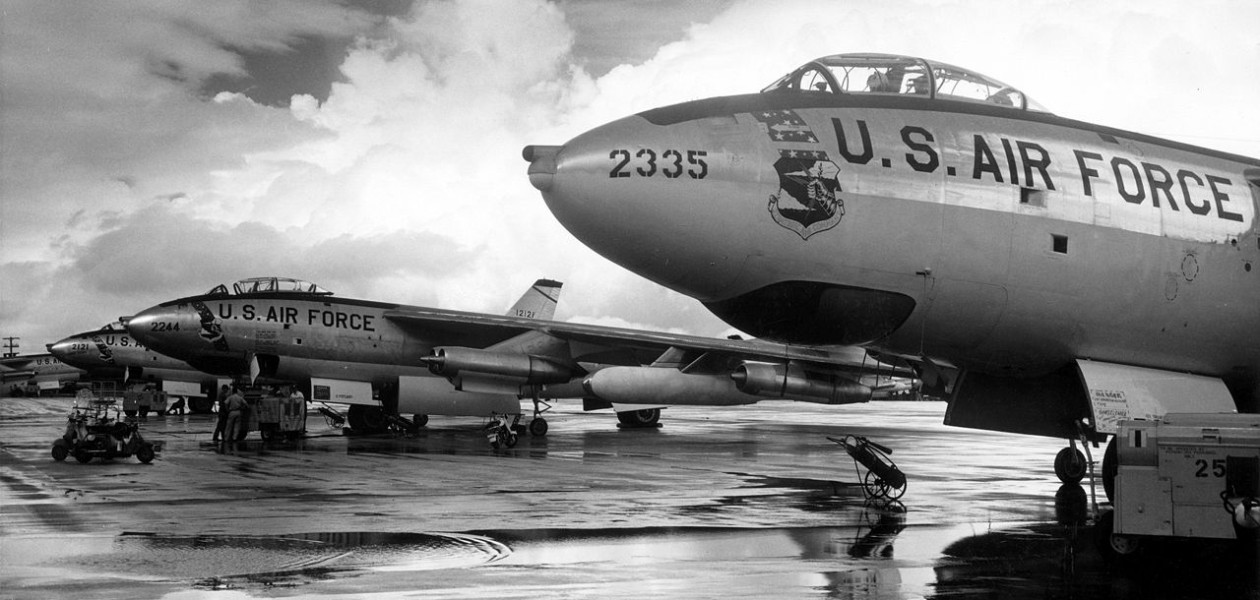
|
|
|
|
An inside look at
the USAF's first jet bomber by: Walter J Boyne Source: Flight
Journal. The
XB-47 first flew on December 17, 1947, with test pilots Bob Robbins and Scott
Osler at the controls. (Osler was the first pilot to lose his life in a B-47 in
a freak accident with the canopy.) The few people watching that day had no idea
that this $13 million project would prove to be the most significant multi-jet
aircraft in history and would begin a dynasty of Boeing jet aircraft extending
well into the next century. With
its 35-degree sweptwings and six podded let engines, the radical XB-47 owed its
configuration to American genius and the design data brought in from post-WW II
Germany. Testing and development would not be easy, but the Air Force would buy
2,042 (some accounts say 2,032). It served the Air Force well as a bomber, a
reconnaissance aircraft, a weather plane and a test bed, and it generated a host
of stories about its quirks, hazards and accomplishments. Only
someone who had flown piston-engine bombers could really appreciate the
wonderful qualities of the B-47. It was a mixture of advanced new design and
Boeing's experience of many years of building bombers. It inspired the building
of the B-52, of course, but perhaps more important, the success of the B-47
paved the way for both the KC135 tanker and the Boeing 707 transport, with all
its follow-on designs. For pilots who had flown the Boeing B-29 or B-50, the "Stratojet"
(as it was never called by the people who flew it) was an impressive, damn near
terrifying piece of super-modem hardware. We who were privileged to fly it in
the Strategic Air Command knew that we were part of an elite strike force - the
most powerful in history. The B-47 became our insurance policy. If a nuclear war
had come while we were flying B-50s, we knew that few of us would have made it
back. My own B-50 crew had essentially a one-way mission, with instructions to
bail out over the Ukraine on the way back from the target and seek out
"friendly natives." We didn't count on finding any. If, as was feared
at the time, the Soviet Union launched its armies into Europe, we were confident
that with the B-47, we would roll the Soviet Union up like a cheese blintz and
bomb it in concentric circles from the outside in. We would have won the war in
six days and cut the invading Soviet armies off from their devastated
motherland. There would have been few B-47s lost. The Soviets knew this, too,
and there was no invasion. B-50
days I
won my wings on December 19, 1952, and graduated from advanced multi-engine
training at Reese Air Force Base, Texas. Having finished high enough in the
class rankings to be able to choose my assignment, I elected to fly four-engine
equipment and chose the 93rd Bomb Wing at Castle Air Force Base, California, as
my first operational unit. I was lucky enough to be assigned to the 330th Bomb
Squadron-a happy outfit that flew B-50Ds. Of
course, the B-50 seemed huge at first, but it was a pleasant aircraft to fly
and, I was told, much nicer than the B-29. There were usually 10 in the
crew-aircraft commander, pilot, radar observer, navigator/bombardier, flight
engineer, radio operator and four gunners. The flight engineer was indispensable
because he kept watch over the big Pratt & Whitney R-4360 engines. By using
an engine analyzer to spot an ailing spark plug or failing valve, he could ask
that an engine be shut down as a preventive measure. Three-engine flights were
routine but usually called for precautionary landings. Takeoffs were long, and
both the climbout and the descent were relatively slow. Flight altitudes
depended on the missions, which ranged from seven to 14 hours in length and
usually included inflight refueling, celestial navigation and practice radar and
visual bomb runs. We generally operated at around 25,000 feet, although many
missions were flown at higher altitudes. I
had just become adjusted to the B-50-and in fact, had just flown my first full
flight as an aircraft commander when the word came down that we were converting
to B-47s. There was a mixture of joy and panic, for the B-47 had only a
three-man crew: aircraft commander, pilot and radar observer. The radar observer
also performed the navigator/bombardier functions. In the early days of the
B-47, Gen. Curtis E. LeMay intended that every member of a B-47 crew be
"triple-rated"; that is, all should have the training and wear the
wings of pilot, radar observer and navigator/bombardier. When the B-47s began to
stream into SAC-as many as in service at one time-this was no longer possible.
The advent of the B-47 had a strange effect on the squadron. LeMay had
introduced the concept of the spot promotion into SAC for especially well
qualified crews. In the B-47, the radar observer would be the key to high
performance, and there began an immediate jockeying among the senior aircraft
commanders to get the best radar observers for their own new crews. This
resulted in a lot of hurt feelings as former crew members were abandoned, and it
led to at least one fistfight; in short, it was like the first round draft in the
NFL. For
me personally, it was bad news: I was still about 100 hours short of the minimum
flying time required to enter B-47 training. I watched in dismay as the crews
were rapidly formed and reconciled myself to getting some sort of staff job
while building flying time in the base flight aircraft, which had Lockheed
T-33s, North American B-25s, Douglas C-47s and Beech C-45s. In those fine old
days, you could be current in a number of aircraft, and the base Ops people were
delighted to let you have one to fly on the weekend just to log flying time. But
being young and foolish, I got ticked off and went into the little Quonset hut
where the squadron commander had an office. Fortunately, the CO was away; he
would have thrown me out on my ear. But I cornered the adjutant, pounded on the
desk and demanded to be sent to Wichita for B-47 training, regardless of the
flyingtime requirements. Shrugging his shoulders, the adjutant cut orders for me
go to McConnell AFB to the 3520th Flying Training Wing. I
was placed with a new crew: Maj. Harold McCarty as aircraft commander and Capt.
John Rosene as radar observer. They were WW II veterans and very nice guys,
although both probably had reservations about having a low-time first lieutenant
as a pilot on a plane as sophisticated as the B-47. For
me, it was love at first sight of the B-47. The ramp at McConnell was filled
with what seemed like hundreds of those beautiful aircraft, and I could not
believe my good fortune in being there to fly it. McConnell had an impressive
operation, with three flight sessions every day and a continuous line of B-47s
taking off and landing. The ramp would shake as scores of engines were run up,
sending out dark, rolling clouds of oily JP-4 exhaust that would have made an
environmentalist faint. It was a hot, dry summer in Kansas, and ramp
temperatures often rose well above the 100-degree mark. You could burn your hand
on aircraft metal as you were pre-flighting, and by the time you were ready to
taxi out, your flight suit was soaked with sweat. The heat caused lots of
problems, including long takeoff runs, but training continued unless cockpit
temperatures rose above 140 degrees. Flying
the B-47 Most
of us learning to fly the B-47 had been given a little T-33 time to become
familiar with jet aircraft, but nothing could really prepare us for the
performance of the B-47. First, the small crew made life and discipline much
easier, but it meant much more work. The entire day before a sortie was spent
planning the mission so that all three crew members knew exactly what was
required of each man. You reported three hours before takeoff, and although the
aircraft preflight was much easier than that of the B-50, it still took about an
hour and a half to complete. Inspecting the drogue and brake parachutes was
sometimes a little difficult, as the B-47B trainers at McConnell were pretty
beat up, and hatches and hinges did not always work without a little "chock
maintenance" to get them firmly latched. The bicycle-gear arrangement made
taxiing strange to us at first, but it quickly became second nature. In the summer, the B-47 cockpit got inordinately hot, for after we closed
the canopy, the sun's heat quickly raised the already high temperature. Sweating
so profusely that the oxygen mask slipped off your face, you taxied out to
perform the required pre-takeoff checks, which were vastly simpler than those of
the B-50. Operations at McConnell were typically at fairly light gross weights,
for most missions ran only about four hours. The takeoffs took some adjustment,
for power came up slowly on the General Electric J47 engines, and acceleration
seemed agonizingly slow for the first part of the takeoff run. But about
two-thirds of the way down the runway, the airspeed began to pick up, and then
we were airborne, accelerating swiftly and pulling the nose up to keep a
310-knot climb speed-faster than we flew the B-50 in level flight. Right after
the gear came up, the air conditioner kicked in, and a welcome blast of frigid
air rapidly brought the cockpit temperatures down to a comfortable level. One
month, eight flights and 33 hours later, we were graduated from McConnell and
sent back to Castle to begin operations with the B-47-flying 30 to 60 hours a
month and beginning to learn just how advanced the aircraft really was. In the
air, the B-47 was a beautiful, sensitive aircraft. You could roll it - and some
pilots did - but it was stupid to do so, and more than one dished out to leave a
triangular scar in the ground. Much has been said about the infamous
"coffin corner" where the high-speed and low-speed stalls coincided.
It is true that such a point existed in the flight envelope, but you would have
had to work hard to put yourself in that position on a normal mission. The
requirement to maintain exact speeds right down to the knot during the approach
and landing phase has been overemphasized as well. The B-47 required an
extraordinarily long, flat pattern. At typical landing weights, you'd turn final
at "best flare plus 15" - say, 146 knots at 105,000 pounds - and you
would be aiming to touch down at 123 knots. You did need to control speed, but
just a caress on the throttles could raise or lower speeds a knot at a time.
And, on an instrument approach, you could use differential throttle on the
number-one and number-six engines to keep you on the ILS track. Because
the J47, like all early jet engines, was slow to accelerate, Boeing had devised
a drogue chute that was deployed in the landing pattern and allowed you to
maintain the engine at a relatively high power setting from which a go-around
could easily be made. Once on the ground, the brake chute assisted the excellent
anti-skid brake system to get you stopped. The brake chute had another use: if
you hit front-wheels-first and bounced on landing, you could - if you knew just
when to do it - deploy the brake chute and bring the airplane down to a perfect
rear-wheel-first landing. The
precise power control made formation flying relatively easy in the B-47. We
rarely practiced it, for the B-47 was intended to be a lethal penetrator, flying
alone, or in well-spaced cells of three or more aircraft. Perhaps
the most critical situation in the B-47's flight regime was the loss of an
outboard engine after you were committed to a high-gross-weight takeoff. You had
just 1.7 seconds to make the control inputs necessary to prevent an
uncontrollable roll-due-to-yaw situation. If you failed to react correctly by
shoving in full opposite rudder, you would lose directional control, and the
aircraft would cartwheel. There are too many films of B-47s doing just that, and
they all end in massive explosions. The
Boeing KC-97 tanker was still in widespread use, and the speed differential
between the two aircraft made in-flight refueling difficult at higher gross
weights. The tanker would be flying along at full power, with the B-47 coming in
to connect at just above its stall speed. As the B-47 took on fuel, it would
have to increase its airspeed, and this meant that the tanker would have to
begin a descent to increase its own airspeed. In just such a descent, I once
looked up to see a big puff of black oil as the KC-97 blew its number-one
engine. The KC-97 seemed to accelerate in reverse as it whipped back overhead,
unable to maintain airspeed because of the loss of power. We dived under it,
lucky to have avoided a catastrophic midair collision. The swift, swept-wing
KC-135 was much more compatible for refueling in flight. My
aircraft commander was a conscientious guy who made sure I got my share of
takeoffs and landings, along with in-flight refueling experience. There was
plenty of flying time that included some 24-hour missions - long enough to spend
in an ejection seat. In
SAC, every crew position was evaluated continuously during dreaded spot checks
by instructors in the squadron, by members of the Wing Standardization Board and
by visiting firemen from SAC headquarters. Because of this, your performance had
to stay sharp; otherwise, you could be unceremoniously removed from a crew. It
turned out that we were doing pretty well as a crew, and we were given Lead Crew
status - a step toward the coveted Select Crew designation, which in turn led to
the possibility of spot promotions. Despite
this, I have to say that my most memorable experiences in the B-47 at Castle
were bonehead mistakes I made and was lucky to survive. The first one came on a
united simulated combat mission, during which the entire wing was launched, just
as if war had been declared. On one of these, an aircraft crashed on takeoff and
sent huge black clouds boiling up off the end of the runway. The mission went
on, with airplane after airplane taking off over the burning crash site - each
one giving a mental salute to the poor guys who had died. (And you knew your own
family would be terror-stricken because although news of the crash would spread
instantaneously, the identities of the crew members would not be released for
hours.) On
the day in question here, the mission was to be a long one, and fuel management
was critical, as it always was in the B-47. During the climb-out, the radar
observer reported that the bomb-bay doors' position indicator showed that they
might not be fully closed and locked. This was bad news, for if the doors were
even slightly open, the increased drag would increase fuel consumption to a
point at which we would not be able to complete the mission as planned. McCarty
leveled the plane off at 25,000 feet, and I volunteered to go down and take a
look. This involved getting out of my seat, edging a few feet down the narrow,
equipment-filled aisle, opening the entrance door and then climbing down the
entrance ladder to the crawlway that led back about 15 feet to the bomb bay. We
had to depressurize to open the door to get to the passageway, so I hooked up
the emergency oxygen walk-around bottle, which had a nominal 10-minute duration
- just enough to get down and back, or so I thought. I
got all the way to the point at which I could see that the bomb-bay doors were
indeed up and locked, when all of a sudden, things went black. McCarty saw that
my legs had stopped moving, so he made an emergency descent. I came to at about
10,000 feet, climbed back up into my seat, and we landed. Afterward, I had a
private interview with Director of Operations Col. Pat Fleming, a 19-victory ace
for the Navy during WW II. He had a reputation as a disciplinarian, and I
expected him to tear off a piece of my tail, but he was as kind as he could be,
making sure first of all that I was really OK. He then made notes on the
incident, which showed that a walk-around bottle might have a 10-minute supply
when sitting in an altitude chamber but not when you were crawling around the
inside of a B-47. (Col. Fleming died just two years later in the first crash of
a B-52.) When
word came down that the 93rd was to be the first wing to transition to B-52s,
another scramble began to get the best crews. This time, the requirement to be a
copilot had been raised to 1,000 hours, and I knew there was no way I'd be able
to talk my way into a slot. A
decision was made that the Wing would retain its combat status through the
transition and keep the B-47s in operation as the B-52s came on line. This gave
me time for one more adventure. We
were coming back from a long mission with the fuel "right on the
money," meaning that we had enough to make the high-speed penetration, land
and then shoot a few touchand-go's, a couple of which would be mine. In a normal
B-47 descent, about 50 miles out, the aircraft was slowed to 305 knots
indicated, and the landing gear was extended to provide some drag. We
did that-and got a series of red lights on the landing gear. McCarty leveled off
at 10,000 feet and decided that we had better use the emergency gear-extension
system to get the gear down and locked before we ran out of fuel. I
left my seat and went back to the left hand side of the cockpit, where the four
levers used for emergency gear extension were. McCarty slowed the airplane to
about 200 knots, and I began to pull the levers. The first full stroke unlocked
the up-locks and allowed the gear to free-fall. Then I had to operate the
emergency extension levers with full strokes, back and forth until the gears
were down and locked. After a lot of huffing and puffing, I got green lights,
and McCarty reported the gear down and locked. Breathing hard, I got up to crawl
back into the ejection seat and get ready for landing. As
I started to step up and move forward to climb in, I heard a bang; the aircraft
had depressurized. I realized at once that the D-ring on my parachute handle had
caught the left ejection-seat handle and initiated the ejection process. I
stopped and stared down at the seat, not knowing what was going on. I prayed
that the rest of the ejection sequence would not follow because if it did, the
upper half of my body would be blown out of the cockpit, putting a crimp in my
future plans. The
next 10 seconds seemed to take about two hours, but I finally realized that the
left-hand grip was all that had moved and that neither the seat nor my upper
body was going anywhere. I got the safety pin in the ejection seat, strapped
myself in, and we landed. This time, I only had to talk to the squadron CO. Despite
my two misadventures, I had learned to love the B-47 and wanted to keep flying
it, but first, I took the opportunity to go back and pick up my degree at the
University of California at Berkeley. Then I was sent to the 4925th Test Group
(Nuclear) at Kirtland Air Force Base. It was a small outfit, with two B-47s, two
B-52s and a handful of Century Series fighters. The other pilots were all
veterans of WW II, and most of them were high time B-47 instructor pilots from
McConnell. They were superb professionals - the very finest pilots and the finest
radar observers I had ever met. The missions included the live drop of nuclear
weapons, which we did in Operation Dominic, the last series of live nuclear
drops in history. I
was quickly checked out as an aircraft commander and began to enjoy the B-47
even more. It was hot at Kirtland during the summer, and the field's altitude of
5,000 feet made heavyweight takeoffs seem impossibly long. You would sit with
the throttles bent forward and watch the runway markers ease by, waiting for the
end of the runway, all the while knowing that after a short overrun area, there
was nothing but a big rough patch of rocks and a cliff. But the B-47 would
gradually accelerate, the numbers would be just right and at the last moment,
the gear would lift off and you would be flying. Most
of the missions at Kirtland were shorter than the typical SAC mission. They
usually involved taking off and flying to a bombing range - White Sands,
Tonopah, or the Salton Sea were used most often - and setting up a pattern. The
bombing range would get its telemetry set up, we'd fly a practice run or two and
then come in and drop whatever it was we were carrying, bomb, missile, or test
vehicle. When
things went well with the telemetry, we had often finished our mission within an
hour of arriving at the range. This meant we had to burn off some fuel before
landing, so we often dropped down to about 10,000 feet and cruised through
whichever mountain range was nearby to check out fishing spots and even watch
herds of antelope run. Then we'd go back to practice some instrument approaches
and shoot a few touch-and-go's before calling it a day. The
more I flew the B-47, the better I liked it, and I eventually felt completely
comfortable in it, no matter what the mission was. It was a time when new
weapons and tactics were being introduced, and we were tasked to drop everything
from spiked runway penetration bombs to simulated nuclear weapons to strange
shapes that were picked up in midair by Fairchild C-119s using recovery gear. We
had no way of knowing it at the time, but this was the technique used to recover
capsules from the Discoverer (Corona) series of spy satellites. Of
all the missions, the most fun was the low-level work done in tests of the
"pop-up" technique. The mission called for a low-level approach - 55
feet or less-across the desert floor at 450 knots indicated. This posed a bit of
a challenge because at 440 knots, your roll rate dropped to zero due to aileron
reversal. The flexibility of the wing allowed a downward-deflected aileron to
produce an upward force that caused a nose-down twist of the wing. Essentially,
you had no ailerons at 450 knots; if anything went wrong, all you could do was
chop the throttles and pull back on the control column to climb. It
didn't help much that the handbook noted that the flutter limit for the B-47 was
440 knots indicated. But having said all that, there was nothing more exciting
than to be cleared into the range, drop down to sagebrush level and send a
450-knot blast of wind through the sand until you began the pull-up. As speed
bled off, the ailerons came back into play; then, you would level off, the radar
observer would drop a simulated bomb, and it was time to do it again. I
checked out as an aircraft commander in the B-52 at Kirtland and enjoyed it very
much, even though it flew like a truck compared with the B47, which was being
retired. The B-47 had a relatively short service career by today's standards;
SAC phased out its last two B-47s on February 11, 1966. A few soldiered on as
weather planes or test beds for a few years after that. For
some reason, the B-47 never captured the public's imagination and was quickly
forgotten-except by the people who flew it, for it made an invaluable
contribution to aviation and to the defense of our nation. Fortunately, you can
still see just how beautiful the B-47 was in flight in the film "Strategic
Air Command," which, despite its silly love story, portrays SAC and the
B-47 in their finest hours. Copyright
Air Age Publishing Apr 2002 Boyne is the former
Chairman of the Board of Wingspan, the Air and Space Aviation Channel, and
President of his own firm, Walter Boyne Associates. The author of 38 books, he
is one of the few persons to have had bestsellers on both the fiction and the
non-fiction list of the New York Times.
|