THREE TODAY IN TAMPA BAY

By Colonel (Ret) William W. Simmons

There was a period in the early history of MacDill AFB, Tampa, Florida, that the phrase, “One a day in Tampa Bay” was coined as a result of the large number of aircraft flying out of MacDill that crashed in the bay.  However, this period of time was well before the following incident that occurred on September 26, 1960, which a reporter for the Tampa Tribune stated in part that, “the chain of events would rival the hottest chapter in the Perils of Pauline”.


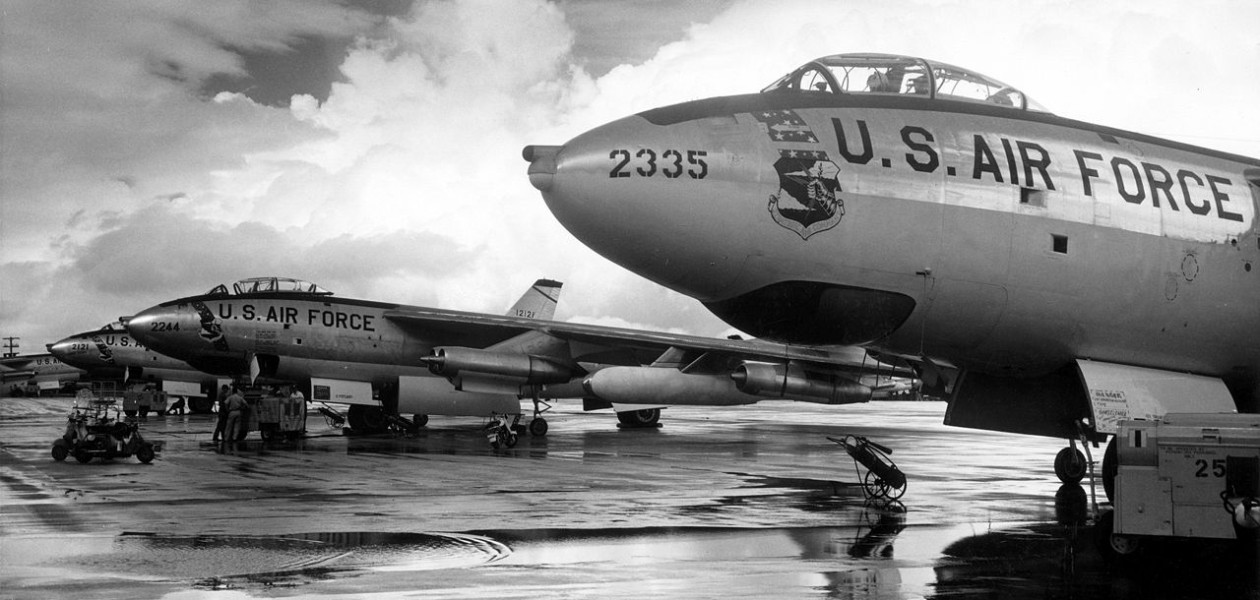
Our combat crew was assigned to the 306th Strategic Bomb Wing at MacDill AFB.  The crew consisted of 1st Lts. Roland W. Korte (Age 30), Aircraft Commander, William W. Simmons (Age 25), Co-pilot, and Harry A. Sheffield (Age 29), Radar Navigator.  All of Lt. Korte’s prior experience had been in fighter aircraft.  Lt. Simmons had two years prior experience as a navigator in transport aircraft, returned to pilot training and upon graduation in 1960 was assigned to B-47 Combat Crew training at McConnell AFB, Wichita, Kansas.  Lts. Simmons and Sheffield completed Combat Crew Training on the same crew and were assigned to Lt. Korte’s crew upon arrival at MacDill AFB in the summer of 1960.


On September 26th, 1960, our crew was scheduled for a routine training mission with a 6:40 PM take-off time.  We also had a fourth man scheduled to fly in the crawlway seat.

Upon completion of the exterior preflight, we boarded the aircraft.  Just prior to engine start, we were advised that the fourth man would not accompany us and he was told to deplane.  After his exit, we proceeded with engine start, taxied to the active runway and were cleared for take-off.  Weather conditions were excellent.  It was clear with very light wind.  Take-off and initial climb was normal.  As we were passing through 1800 feet, we heard an explosion, looked to our left and saw flames around the area of the left outboard engine. The aircraft immediately started a roll to the right. We were unable to override the roll with full opposite controls and Lt. Korte gave the order to bailout.  (The accident investigation determined that the aft engine mount pin on the number 1 engine had failed allowing it to fall down while still producing power and catapult the aircraft into an extreme right roll.)  By this time, the aircraft was rolling through 90 degrees.  Lt. Sheffield and I initiated the ejection sequence and separated from the aircraft as it was rolling through approximately 120 degrees.  Lt. Korte had delayed his ejection until we ejected.  By this time, the aircraft had rolled 180 degrees and was upside down.  Lt. Korte delayed his ejection until the aircraft rolled approximately another 90 degrees to allow him to eject horizontally instead of straight down.


Upon hearing the order to bailout, I immediately initiated the ejection sequence.  I remember the canopy blowing, the seat bottoming and the tremendous force of the wind that hit my body as the ejection seat departed the aircraft.  I momentarily “blacked-out” and don’t remember losing my helmet.  I vaguely remember separating from the ejection seat.  The next thing I remember was looking up at my deployed parachute and then looking down at the water below.  I said several “thank you god” and deployed my dinghy.  After a few seconds, I disconnected my chest harness strap but didn’t inflate my life vest or release the guards on the parachute quick releases on my harness (contrary to our survival training procedures).  I remember thinking that there was no way I was going to touch the quick release guards until my dinghy hits the water.  Shortly thereafter my dingy hit the water, I pulled the guards down, my feet hit the water, and I depressed the parachute quick releases.  I entered the water at a slightly higher speed and descended to a lower depth than one experiences when jumping off a high dive board.  I deployed my life vest and when I popped to the surface my dingy was within arms reach.  I had often wondered if I would have a problem getting into my dinghy if I ever had an occasion to use it.  There was no problem!!  I grabbed the sides and propelled myself in it on the first shot.  In fact, I almost jumped over it!!  I rolled over on my back, said several more “thank you god”, and disconnected the dinghy strap attached to my harness.  I’m now safe in my dinghy and the sharks can’t get me.  All I have to do now is wait for someone to come get me.


Shortly thereafter I hear a helicopter approaching.  It hovers above me and I see a basket being lowered.  The basket is maneuvered to the side of my dinghy; I grab it and roll out of my dinghy into it.  I become airborne again as it is raised to the door of the helicopter and the Coast Guard crewman operating the hoist helps me into the helicopter.  I take a seat in the rear facing forward toward the door.  The helicopter moves a short distance and hovers again.  I see the basket being lowered.  When it is raised to the door, Lt. Sheffield is helped into the helicopter and joins me in the rear facing aft.  We both still have on our life vests and are congratulating ourselves on our good fortune as the helicopter moves another short distance and goes into the hover mode again.  I see the basket being lowered and in a few seconds the helicopter starts forward without the basket being raised.  (We didn’t know at the time that the helicopter was losing power and the pilot pushed the controls forward to avoid descending on Lt. Korte.)  I see water approaching the door and suddenly realize we are descending into the bay.  All of a sudden the water is at door level and the Coast Guard crewman in the door yells “let’s go!!” and jumps out into the water.  The helicopter continues to settle into the water and starts rolling to the right (this is apparently the night for right rolls!).  I race to the door and exit as the door is about half submerged with water rushing in.  I think, “oh my god, the helicopter is sinking, my life vest is going to pop me to the surface of the water and the rotor blades are going to cut my head off and kill me”.  I stay under the body of the helicopter to prevent being popped to the surface until I run out of breath.  I pop up and the blades have stopped rotating.   About this time, Lt. Sheffield surfaces next to the helicopter without his life vest flailing his arms and screaming, “I can’t swim! I can’t swim!  (By the time he had gotten to the helicopter door to exit, it had rolled so much that every time he attempted to get out the incoming water would push him back in.  In order to exit, he had to take off his life vest and go under water to get out the door opening.)   I swam over and grabbed him.  The helicopter remained partially afloat with the three helicopter crewmen sitting on top of the cockpit area.  Lt. Korte swam up and he, Lt. Sheffield and I hung on to the body of the helicopter.  I start thinking about sharks again. I had left the safety of my dinghy for the helicopter to be rescued.   Now its dark,  I’m back in the water without my dinghy, needing to be rescued again, dangling and waiting to be eaten.  It just isn’t my night!


Pretty soon we hear an outboard motor and one of the helicopter crewman fires a flare.  We start yelling and the boat reaches us.  It’s a fifteen-foot boat with a father and his teen-age son.  The teen-age son had been outside their house (which was near the location that our B-47 and the helicopter crashed), saw the B-47 and the parachutes, ran in and told his father that there was a plane crashing in the bay.  They  went outside, hooked the boat and trailer to his father’s car, drove to the bay, launched the boat, and subsequently found us.  We six crewmembers got in the boat with the father and son and  headed toward shore approximately two miles away.  I think, “Safe at Last! Safe at Last!  Thank God I’m Safe at Last!”   The sharks can’t get me and I don’t have to worry about this thing falling out of the sky!  (It’s funny how your mind works in situations such as this.  It all my experience in flying over water, the worst fear I had was that I would wind up in the water and be attacked by schools of sharks.  There probably was not a shark within ten miles of me in my various locations in the bay that night.)  With eight of us in the small boat, it was overloaded and running very deep in the water.  We traveled about 30 yards and ran aground.  (When the helicopter crashed, we didn’t realize that we were on the western edge of the ship channel and the water was only about chest deep once you got out of the channel.)  We six crewmembers jumped out the boat, pushed it off the mud flat and walked along side until we came to an area of the flats that had more depth.  We got back in the boat and continued slowly to shore where we were met by a crowd of on-lookers.


Someone called MacDill, gave them our location, and about 45 minutes later an Air Force ambulance picked us up and transported us to the hospital.  The flight surgeon checked us, found no injuries, and kept us overnight for observation.  (It was subsequently determined that Lt. Korte had torn some tendons in his shoulder during the ejection sequence and they were surgically repaired. )


Now that I’m in the hospital and don’t have to worry about sharks anymore, I began to worry that I might have been castrated when the parachute deployed.  I remembered being told during survival equipment training that if your parachute harness leg straps were to loose when the parachute deployed it could castrate you (in retrospect, I think this was an extreme example used to impress upon us the necessity of having the harness snugly adjusted).  I couldn’t remember how tight mine were prior to take off but I’m happy to report, “They were tight enough”.


We learned the next day that when our helicopter went down the Coast Guard had immediately launched a second helicopter that had also lost power and crashed in the vicinity.  All four of its crewmembers were also rescued with no injuries.  We heard that both helicopters had launched immediately after engine start without allowing the engines too sufficiently warm up.  As a result of the weather conditions (high humidity and calm wind) and hovering close to the water surface of the bay, the engines developed carburetor ice, lost power, and went in.


We continued to fly as a crew until 1963 when we were assigned to B-52 crew training enroute to our assignment to the 462d Bomb Wing at Larson AFB, Moses Lake, Washington.


We were extremely lucky that night, but the luckiest person alive was our fourth man that had deplaned just prior to engine start.  Without an ejection seat, I’m convinced there is no way he could have egressed the aircraft and survived prior to its impact in the bay.