B-47 Stratojet Association


 Chapter 2


 The B-47A


 B-47A take off


On November 22, 1948, the Air Force issued a letter contract for an initial order of ten B-47A production examples, and the future procurement of three more B-47As and 41 B-47Bs. The three additional B-47As were later canceled. The ten B-47As were scheduled for delivery between April and November 1950. 


In June of 1949, the B-47 program was substantially increased, and the number of B-47Bs was increased to 102. On November 14, 1949, the Air Force amended the contract to call for a total of 87 B-47Bs. 


Unlike the two Seattle built prototypes, the B-47As (company designation Model 450-10-9) were all manufactured at the government owned but Boeing operated facility in Wichita, Kansas. Having ceased production of aircraft following the end of World War II, military planners insisted that for strategic reasons, the new medium jet bomber be built at the idle Wichita plant. 


The first B-47A flew on June 25, 1950. It took another year to deliver all ten B-47As on the order. The B-47A was powered by six 5200 lb. static thrust J47-GE-11 turbojets and retained the built-in JATO feature of the prototypes. It increased takeoff weight from 121,080 pounds to 151,324 pounds. The B-47A was essentially a service test version of the XB-47, and was essentially identical to the XB-47 prototypes. They were test and training models for both the Air Force and the manufacturers, and were not considered combat ready. 


Throughout 1950-51, flight testing of the B-47A as well as the first XB-47 continued. Unfortunately, neither plane was very safe to operate. Both the XB-47 and the B-47A were found to be seriously under powered, and suffered from critical braking problems occurred during aborted takeoffs and after high gross weight landings on wet runways. 


To reduce the length of the landing run, a 32-foot deceleration or brake parachute was provided that was stowed underneath the tail, just forward of the tail cone. Conventional solid parachutes could not stand the load without ripping, so a special ribbon type parachute originally developed in Germany was designed. This chute was deployed immediately after touchdown to help slow down the aircraft and shorten the landing roll. 


Since the poor acceleration characteristics of the jet engine made go-arounds after an aborted landing hazardous, a second and smaller sixteen-foot drogue or approach parachute was developed that acted as an in-flight air brake that made it possible to make landing approaches at relatively high engine powers. If a go-around became necessary, the approach chute could be jettisoned and the airplane could accelerate quickly. If the landing was normal, the approach chute could be left attached while the main brake chute was deployed. 


Following the end of the landing roll, both the approach and brake chutes were jettisoned after clearing the runway before the B-47 taxied in. The chutes were recovered and repacked by the ground crews. 


There were problems with the ejection seat equipment. The ejection seats were removed after an XB-47 accident in which the pilot was killed. As a substitute, a bail-out spoiler was provided underneath the nose so that the crew entry door could be used for egress. 


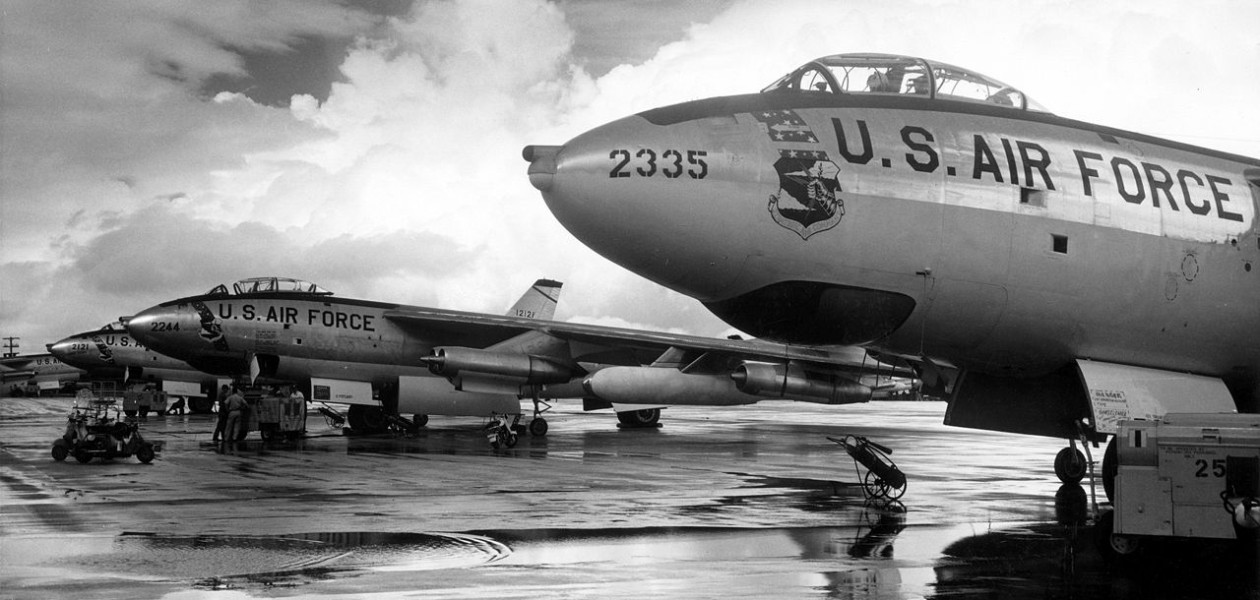
Deliveries of the B-47A to the USAF began in December of 1950. The B-47A entered service in May of 1951 with the 306th Bombardment Wing (Medium) based at MacDill AFB in Florida. The 306th was intended to act as a training outfit to prepare future B-47 crews. None of the B-47As ever saw any operational duty. Most of the B-47As were unarmed and were initially almost without vital electronic components. Only four of the ten had the K-2 bombing navigation system. The tail armament of two 50-caliber machine guns was tested with an A-2 fire control system on 49-1906 and with an A-5 fire control system on 49-1908. Some of the B-47As stayed with the Air Proving Command. 


Serial Numbers of the Boeing B-47A Stratojet 49-1900/1909 (10)

Specifications of the Boeing B-47A Stratojet:

Powerplant:

Six General Electric J47-GE-11 turbojets, each rated at 5200 lbs. static thrust.

Performance:

Maximum speed: 600 mph (521 knots) at 8800 feet.
Service ceiling: 38,000 feet.
Combat ceiling: 44,300 feet.
Initial climb rate: 3375 feet per minute.
Combat radius: 1550 miles (1347 nautical miles).
Range: 2650 miles (2304 nautical miles) with a 10,000 pound bombload.
Ferry range: 4000 miles (3477 nautical miles).
Takeoff ground run: 6000 feet at sea level.

Dimensions:
Wingspan: 116 feet 0 inches.
Length: 106 feet 9 inches.
Height: 27 feet 8 inches.
Wing area: 1428 square feet.

Weights:
Empty: 73,240 pounds.
Normal: 106,060 pounds.
Maximum takeoff: 157,000 pounds.

Armament:
Two 50-caliber machine guns in tail turret (not installed in the B-47A).

Bombload:
Normal: 10,000 pounds.
Maximum: 16 1000 pound bombs or one 22,000 pound bomb. 


Additional material provided by Robert M. Robbins, Lt. Col. Andy Labosky and Mark Natola

logo.jpg

Previous Chapter | Return to History Menu | Next Chapter