McConnell AFB Heritage Park


THE HISTORY OF B-47E,  53-04213

This information was compiled by Andrew Labosky Jr.

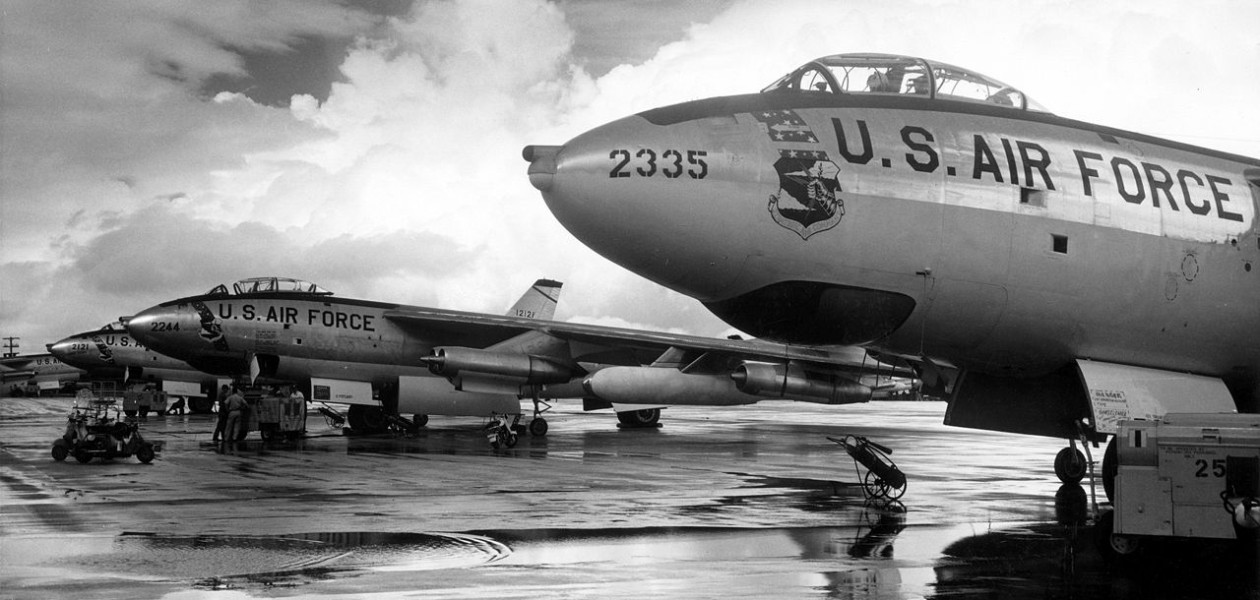
This is a history of the Boeing B-47E Stratojet, serial number 53-04213.  The aircraft is displayed at McConnell  Air Force Base, Kansas.  There are twenty-five B-47s on display in the United States, representing eight different models of the aircraft.

The aircraft was manufactured by Boeing Aircraft, Wichita, Kansas, and delivered to the USAF on  26 March 1956.  It was the 1007th of over 2042 B-47 Stratojets produced by Boeing.  The total number of the model B-47E produced was 1341.  It was assigned to the 308th Bombardment (Medium) Wing of the Strategic Air Command (SAC) at Hunter  Air Force Base (AFB), Georgia.  The Wing deployed to Sidi Slimane Air Base in Morocco.  The aircraft was then assigned to the 98th Bombardment Wing, Medium, (SAC) at Lincoln AFB. Nebraska.  It was dropped from the USAF inventory on December 1965 and transferred to the USAF Museum inventory.

 The USAF presented the B-47E to the city of Wichita as an “Air Memorial” and was delivered to the Wichita Airport in December 7, 1965.  It was officially received by the then Mayor William Tarrant.  The aircraft remained parked at the airport for 455 days because of delays in planning the movement of the aircraft and establishing the  monument site.  The aircraft was moved to the site where the engines and some internal equipment were removed.  The site chosen was located about a mile northwest of the airport, next to Route 54 on the west edge of  Wichita, near Tyler road.  A massive twenty foot high concrete pedestal was constructed with the assistance of the Walt Keeler Company and in December 18, 1969, cranes donated by Belger Cartage Service Inc. lifted the aircraft and positioned  on the pedestal facing west.  The aircraft was displayed on a “V” pylon to give the impression of flight.  The landing gear was removed and the gear doors were closed.   Volunteers donated their time to move and prepare the aircraft for display.  The display was constructed at no cost to the taxpayers.

In February 1988, after eighteen years at the Air Capital Memorial Park site, Dondlinger and Sons Construction Company had the task of

lifting the aircraft off the pedestal and moving it to  McConnell AFB.  The wings were cut off and the tail was dismantled so it could be transported by trailers provided by Western Kansas Xpress to McConnell AFB on 16 March 1988.

 It was interesting from a historical point of view that the aircraft was towed through the Boeing complex, through the Boeing flight ramp and across the runway where it had departed in 1956.

 The aircraft was placed in hangar 1218 and over 30 volunteers replaced sheet metal, scraped and sanded the old paint, replaced the canopy, replaced the landing gear, repainted and applied the standard decals and emblems.  The project received support from area businesses for the transport and the restoration of the aircraft.  After the restoration was completed, the cranes were again donated to lift the B-47E onto a pedestal supporting the main gear and the outrigger landing gear on 18 July 1988.   Plaques and monuments were positioned at the front of the aircraft.  A monument to those who lost their lives while serving in the 3520th Combat Crew Training Wing, responsible for all B-47 training at McConnell AFB., for SAC,  was dedicated during a ceremony on 8 October 1993.

 The aircraft was ready in 1999 for another restoration and a move to a new site located south of the first production model of the KC-135 on display south of the main gate.  On 19 July 1999, the monuments were moved aside, and on 20 July 1999 the Belger Company attached the cables to the wing root area.  On 21 July,  the aircraft was lifted off of the pedestals by two massive cranes and gently positioned on the ground for the tow to hangar 1166.  The computers in the Belger crane registered the gross weight of the aircraft at approximately 61,000 pounds.  Before being stripped of equipment and engines, the aircraft dry weight was over 83,700 pounds.

 The aircraft was reconditioned and painted by the 22nd Maintenance Squadron (MXS) to the original specifications of it’s first assignment.  It was then towed to the new site in McConnell’s Memorial Park at the east gate on 11 October, and lifted by the Belger Cartage Company cranes to rest on the pedestals on 12 October 1999.

 Wiring was added to the aircraft for illumination of the navigation lights and other areas of the aircraft.  The navigation lights included the red light on the left leading edge of the wing near the left wing tip, and the green light on the right wing.  Lights on the vertical stabilizer and the anti-collision lights on the top and bottom of the fuselage are illuminated.  Extra area lights are installed in the canopy and landing lights located in the inboard engine pods.  The entire aircraft is illuminated by floodlights. 

 On  12 June 2000, the aircraft was rededicated by  a large ceremony   with 200 in attendance.  Colonel Fredrick Roggero, 22nd Air Refueling Wing Commander, rededicated the B-47 Stratojet as a “monument to honor the people that built, flew and supported the B-47 and its mission.”  The B-47 is now part of the Memorial walk, which honors those with special ties to McConnell AFB who have lost their lives in the services of their country .  Many attendees were B-47 Stratojet Association members who are former Boeing employees who originally designed and built the aircraft, retired Air Force members who flew and maintained the aircraft,  friends,  relatives, and aviation enthusiasts.  Many of the association’s members worked side by side with personnel of the 22nd Maintenance Squadron during the restoration. Their knowledge and expertise of the B-47 made it possible to accurately repair and restore the aircraft.

 The guest speaker for  the ceremony was retired Colonel Walter Boyne, a former B-47 pilot, historian and accomplished  author.  Boyne, during his speech, described the B-47  as the  most  important multi-engine jet ever built because many of the design features have become standard for every modern jet built today.  He mentioned the planes swept wings and pod mounted jet engines as some of the contributions.  A B-52 from the 5th Bomb Wing, Minot AFB, N.D., and a B-1 from McConnell’s Kansas Air National Guard, 184th Bomb Wing provided a flyover as a tribute during the presentation.

 There are two large monuments erected beside the aircraft.   A bronze plaque installed below the front main gear lists the volunteers for this effort.

******************************************************************

B-47E  # 53-04213  RESTORATION HISTORY

Over eighty panels and structures were replaced.  The sheet metal shop was successful in restoring the panels and structures without the aid of blueprints.  More than 700 feet of wire was installed to enable the aircraft lights to operate from a 28 volt AC power supply while the aircraft is on display.  Over 100 stencils were prepared, and fifty-five gallons of latex paint was applied to the aircraft.

 During the sanding process, the specialists were required to wear environmental suits to protect themselves from the paint dust.  During the high temperatures experienced in July and August, they could only work about 30 minutes without a break from the heat.  The new chemical warfare suit cooling vests were added to the suits which allowed them to work at least an hour before a break.  The restoration was also used to train new corrosion control and sheet metal specialists without an impact to the main mission of the unit.  During restoration, the USAF hosted many tours of the work in progress and welcomed members of the B-47 Stratojet Association, USAF active duty and retirees. Many Boeing retirees who actually built this aircraft in 1953 were also welcomed. 

Many of the USAF retirees visiting the aircraft were stationed at McConnell AFB. When the B-47 was operational.  McConnell AFB. Was the home of the B-47 Combat Crew Training Wing.  The 3520th Flying Training Wing (ATC), later changed to the 3520th Combat Crew Training Wing (ATC) and then the 4347th Combat Crew Training Wing (SAC) conducted operations.  The last operational flight of a B-47E from McConnell AFB. was in June 1963. 

ADDITIONAL RESTORATION HISTORY:

The monuments, plaques and the aircraft were vandalized while it was parked at the Wichita airport.  After it was mounted on a 20 foot high pedestal on the west side of Wichita, it was continually vandalized and was the target of gunfire.  More than 53 bullet holes were counted when it was removed for transport to McConnell AFB.  In addition to the bullet holes, the canopy was smashed by vandals allowing birds to roost inside the cockpit.  The interior was stripped by vandals. 

After it arrived at McConnell AFB. From west Wichita, two USAF retired volunteers entered the aircraft cockpit to dig out over two feet of dead birds and debris.  The active duty battle damage repair unit patched the bullet holes.  A new canopy was obtained from the USAF museum.  Since it was mounted on a pedestal at the west Wichita site, to simulate flight, the landing gear had been removed and salvaged.  However, the base personnel managed to locate the last landing gear  struts available from Davis Monthan AFB. Arizona.  The main tires for the B-47 could not be found, so B-52 tires and rims from Boeing were installed along with parts and hubs from a KC-135 aircraft.                                                                                   

During preperation for the lift off of the aircraft from the pedestal on 21 July, 1999, engineers from Boeing helped advise the crew about the weight, center of gravity and the lift points.

The aft Electronic Countermeasures radome, (Phase III ECM) was removed before the move and the equipment bay was the site of the aft lifting strap used by the crane.  The landing gear doors were removed to avoid damage during the tow across the field.  The outboard engine nacelles were also removed prior to the move and most of the inboard nacelles were also removed.  The canopy was removed and placed in storage. 

 Upon arrival at hangar 1166 on 21 July 1999, the crew responsible for the restoration of the B-47E opened all of the hatches and covers.  They were not able to open the Navigator’s ejection hatch due to seized gearing in the hatch.

 The aircraft received a complete washdown inside and out and left outside the hangar to dry overnight.   The next day it was towed inside the hangar.   The restoration crew then proceeded to remove additional panels such as the balance bays.  A corrosion control inspection was accomplished to determine what sheet metal repairs were needed.   Many photographs were taken before the move to enable the aircraft to be repainted exactly as it was displayed.  Two of the main gear tires kept losing air pressure so body and wing jacks were used to help support the aircraft.

 OBSERVATIONS:

 It was noted that the plexiglas lens for the landing lights in the inboard engine nacelles were damaged and the navigation lights lens were aged.   It was decided to eliminate the wire antenna attached between the cockpit canopy area to the vertical stabilizer so as to deny a perch for birds.  The telescoping entrance ladder was missing.  A few bundles of chaff were found in the dispenser hoppers and were left in place.

It was interesting to see the “pop bottle” bolts under the leading edge wing to fuselage fairing and the “milk bottle” bolts near the trailing edge wing to fuselage fairing.  Those four bolts fastened the wing  to the fuselage.  The four cables for the lift were routed under each bolt fitting that attached the wing to the fuselage.

 The cockpit area was blotched and stained.  Some of the interior sheet metal had been removed to allow a sealing board to be installed at the canopy rail level to ensure no birds could enter the cockpit area should the canopy be damaged.

 The aft ECM radome was deteriorated and was repaired.  The Bombing-navigation system radome was found to be in good repair. Some of the sheet metal on the underside of the aircraft was corroded from the inside and was replaced.

 Parts not of the original aircraft included; an “H” bar on each outrigger to lock the outrigger oleos at partial extension; modified openings for the main gear well around the strut; locking plates riveted onto the control surfaces; attachment plates and internal I beams to strengthen the wings where they had been rejoined.   Additionally, a large eyebolt was welded near the wing tips.

 OPERATIONAL DETAILS:

 The B-47 is a Jet propelled medium bombardment aircraft.   The most distinguishing features of the aircraft are the swept back wing and tail surfaces.  Provisions are made for a jettisonable fuel tank under each wing and holds 1700 gallons (about 10,000 pounds) of fuel.  The aircraft can be refueled in flight.  It is powered by six turbojet engines; one near each wing tip and two in pods supported by struts below the wing near the fuselage.  Assisted takeoff thrust was available from solid fuel rocket motors mounted on a rack on the aft fuselage and was dropped after use.

 The two tandem main gear are of the dual wheel type and retract forward into the fuselage.  The outrigger gear retract forward into the inboard nacelles.  The forward main gear is hydraulically steerable and both main gear are equipped with hydraulic brakes and an anti-skid system.

 Hydraulic surface power control systems provide power for actuation of the ailerons, elevator and the rudder.  The control surfaces could be manually operated in case of hydraulic failure.  Artificial feel for the controls was provided.  All control surfaces are equipped with trim tab adjustments.

 Thermal anti-icing equipment was provided for the leading edges of the wings, tail group and air refueling door and slipway.

TECHNICAL DATA:                                    

Serial:                          53-04213

Model:                         B-47E-IV

Boeing Model:             450-157-35

Block:                          B-47E-130-BW

Block Spread:              53-04207 through 53-04244

Production:                  Boeing-Wichita

B-47E Total:                1341

B-47    Total                 2042

Models produced:        Eight basic models were produced:

                         B-47A, TB-47B, B-47B, B-47E, EB-47E, R-47E, R-47K, R-47H.

Wingspan:                    116 ft.  0 in.

Length:                        107 ft.  1 in.

Height:                          28 ft.  0 in.

Armament:                   Two M-24  20 mm cannons in the tail turret.

                                      10,000 pounds of bombs.

Maximum bomb size was one 25,000 pound bomb, depending on configuration.

 Engines:                        Six General Electric J-47-GE-25 axial flow turbojet engines of 7,200 lbs. of thrust each.                                     

(Maximum power with water-alcohol injection.  6,000 lbs. without injection.)

Crew:                            Three.  Pilot, copilot, navigator-bombardier.

                                     The copilot was also the radio operator and gunner.

Maximum speed:         610 mph.

Cruising:                       560 mph.

Range:                          Over 3,500 miles.  (Without air refueling)

Ceiling:                        Over 40,000 feet. 

 DETAILS:

 The pilot and copilot occupied a tandem cockpit under a jettisonable canopy.  The navigator-bombardier occupied a position in the nose, forward of the radome.  Catapult-type ejection seats are installed at the pilot’s, copilot’s and navigator’s stations.  During bailout emergencies, the pilot and copilot could eject themselves upward from the cockpit while the navigator could eject himself downward from his station.  Three extra crewmembers could occupy the crawlway below and to the left of the pilots.  The extra crewmembers could use the crew entry chute for emergency bailout. 

A water-alcohol mixture was injected into the engines during takeoff to increase the thrust of the engines.

The aircraft was capable of toss-bombing using an Immelmann manuever.

 STRUCTURE:

 The fuselage is semi-monoque in construction.  The fuselage is fabricated in five sections and consist of the navigator-bombardier’s compartment, main crew compartment, bomb bay area, empennage (not including the tail surfaces), and the tail cone.   The forward two sections comprise the crew compartment and is pressurized.  The nose section begins as a circle structure.  As the sections progress aft, the depth increases, allowing room for equipment.  The sides are flat for a short distance before becoming circular again.   The pressurized crew section is circular within the expanded, outer shell, and is attached to the canopy beam.  The cross section of the canopy is nearly circular in radius.

 The nose pressurized section accommodates the navigator-bombardier-radar operator, radar and bombing equipment, and in-flight refueling equipment.   An exit hatch is provided for emergency exit.   The radar radome is located below and outside the pressurized compartment.  Aft of the crew compartment, the fuselage houses the front landing gear, fuel cells, bomb bays, rear landing gear, assisted takeoff (ATO) attachments, camera, radio radar equipment, drag chute, brake chute and tail turret.  

The high speed design wing requires a very thin airfoil and thus the fuel load and most all of the equipment is carried in the fuselage.   Exceptions are the two external jettisonable wing fuel tanks.  The aircraft was designed with in-field maintenance in mind.   Every cable run, wiring and equipment is identified and labeled, and can be accessed through panels and doors, bomb bay and wheel wells.

 The five fuselage sections are joined by shear and tension bolts at the longeron fittings and around the periphery of the sections.  This design facilitates production and allows easier replacement of sections in case of damage.

 The windshield was electrically heated but the rest of the canopy and other windows were defrosted by ducted hot air bled off of the engines.

 Entrance to the aircraft is through the crew entry hatch on the lower left side.  Other entry points were through the bomb bay.  Emergency entry could be made by jettisoning the canopy and the navigator emergency escape hatch.

 Cable access wells are located along the walkway on top of the fuselage from the canopy to the tail.

 THE WING: 

The B-47 was designed as a high speed aircraft and was at least 100 knots faster than the B-52, especially at low level.  The wing is swept back in order to increase critical speed.  The use of flaperons and aileron internal sealed balances provide stability and control.  The location on the outboard engine near the wing tip is primarily for flutter control and to improve stall characteristics.  The inboard engines pod is placed as far forward and below the wing in order to improve wind flow over the wing.  The wing is designed in sections for ease of maintenance in case of combat damage.

The external jettisonable wing tanks were located between the outboard and inboard engines.  The location and added weight in this location tends to decrease wing flutter and stall.  When the wing tanks were jettisoned, parachutes in the tail cone of the tanks would deploy and pull the tanks clear of the wing.   Each wing is attached to the fuselage by two large bolts referred to as the “pop bottle” and the “milk bottle” bolts.  

*******************************************************************

This information was compiled by Andrew Labosky Jr. for the B-47 Stratojet Association.  Duplication or use of this information requires the permission of the Association due to a continual updating process.

Suggestions and updates are encouraged. 

The B-47 Stratojet Association, a non-profit organization, was formed in 1996 to preserve the legacy of the Boeing B-47 Stratojet and to honor the men who flew and maintained it.  Members include crewmembers, ground crews, support personnel, members of Boeing and other aircraft manufacturers, relatives, modelers and other interested groups.

*******************************************************************

ADDRESS: 

The B-47 Stratojet Associatiom

C/O Bob Griffiths, Secretary

303 Double Eagle Road

Burgaw, NC 28425-8559


logo.jpg


 Previous Page | Return to Preserved Menu | Next Page